
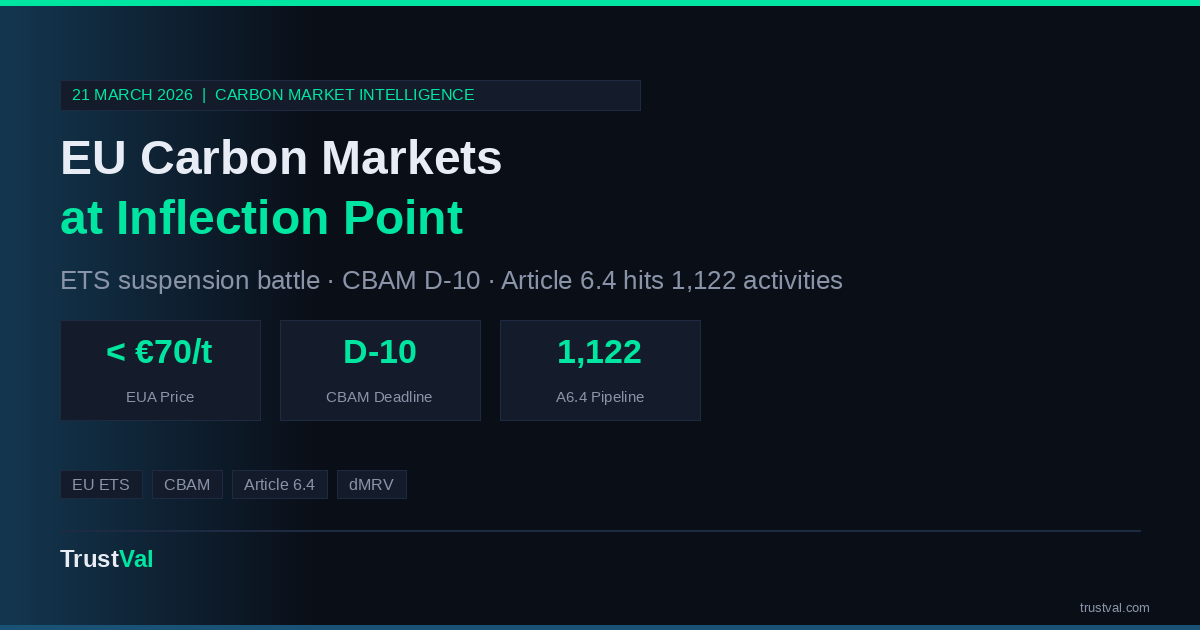
Three forces are converging on European and global carbon markets in the week of 21 March 2026, each carrying material implications for compliance buyers, voluntary credit developers, and the dMRV infrastructure that underpins both. Italy's campaign to suspend the EU Emissions Trading System has pushed EUA prices below €70 per tonne. The CBAM authorized declarant deadline arrives in 10 days. And the UN Article 6.4 mechanism has surpassed 1,122 pipeline activities — scaling faster than the market expected.
On 19 March 2026, Confindustria president Emanuele Orsini issued his bluntest statement yet on the EU carbon market: "Italian industry cannot hold out another six months." Speaking in Brussels, Orsini called for the immediate suspension of the ETS for manufacturing, the halt of ETS2 before entry into force, and the suspension of maritime ETS coverage.
The demand is not new — Italy's government first raised suspension in late February — but Confindustria's intervention raised the political stakes. EU allowance prices have responded, falling below €70 per tonne from levels above €90 in January 2026. Eight member states (Denmark, Finland, Luxembourg, Portugal, Slovenia, Spain, Sweden, and the Netherlands) signed a joint non-paper on 12 March explicitly opposing suspension, sharpening the fault line inside the Council.
The European Commission is expected to bring ETS reform proposals by July 2026 as part of the scheduled ETS directive revision. The most likely outcomes are Market Stability Reserve adjustments or introduction of a price corridor — rather than suspension, which faces legal and treaty obstacles. But uncertainty itself has an economic cost: companies cannot make rational low-carbon investment decisions when the carbon price trajectory is contested at the highest political level.
The Carbon Border Adjustment Mechanism's authorized declarant application deadline falls on 31 March 2026 — 10 days from today. EU importers bringing in more than 50 tonnes annually of CBAM-covered goods (steel, aluminium, cement, fertilizers, electricity, and hydrogen) must hold authorised declarant status or face import blockages.
The stakes are significant. Companies that submitted applications by 31 March can continue importing provisionally for up to 120 calendar days while their application is processed. Those that miss the deadline face immediate enforcement risk. The scope is already expanding: the Commission's December 2025 proposal to extend CBAM to downstream steel and aluminium-intensive products means the authorised declarant universe will grow substantially through 2026 and 2027.
From 2026, CBAM progressively replaces ETS free allowances as the primary carbon leakage prevention instrument. This makes verified embedded carbon reporting — a direct application of industrial dMRV — a compliance obligation rather than a voluntary reporting exercise. Companies using manual calculation methodologies for CBAM are already accumulating measurement risk that certified verification tools eliminate.
The UN's Paris Agreement Crediting Mechanism has reached 1,122 prior consideration notifications as of mid-March 2026, representing a dramatic acceleration in project activity since the mechanism's rules were finalised. The UNEP Copenhagen Climate Centre has updated its Article 6 Pipeline tool to provide granular tracking of the 106 bilateral arrangements formalised to date — including 59 Memoranda of Understanding, 40 Bilateral Agreements, and seven additional arrangements.
The pricing data accompanying this structural development is striking. ClearBlue Markets' 2026 State of Quality and Pricing in the VCM report confirms that high-integrity credits now command a 46% price premium over lower-quality credits. This represents a complete reversal from 2022, when the relationship was inverted. The mechanism's tougher baselines also produce credited reductions approximately 40% below legacy CDM levels — a design feature that concentrates value on verified, genuinely additional emissions reductions.
For project developers and corporate buyers, these data points align: the market is converging on quality as the primary value driver. Projects with robust digital MRV infrastructure — continuous sensor-based monitoring, automated reporting, and auditable data trails — are positioned to capture the quality premium. Projects relying on periodic manual audits are exposed to the growing gap between what the market will price and what manual methodology can credibly certify.
The week of 21 March 2026 illustrates a carbon market in structural transition. The ETS debate is a symptom of a policy system under pressure to evolve. CBAM is the mechanism replacing it as the primary compliance instrument. And Article 6.4, combined with the quality premium in voluntary markets, is building the architecture for a high-integrity global carbon price. dMRV sits at the intersection of all three.
TrustVal helps corporate buyers and project developers navigate carbon markets with confidence. Whether you need CBAM-grade embedded carbon data, Article 6.4-ready MRV documentation, or dMRV-verified voluntary credits — talk to our team.
Talk to TrustVal →