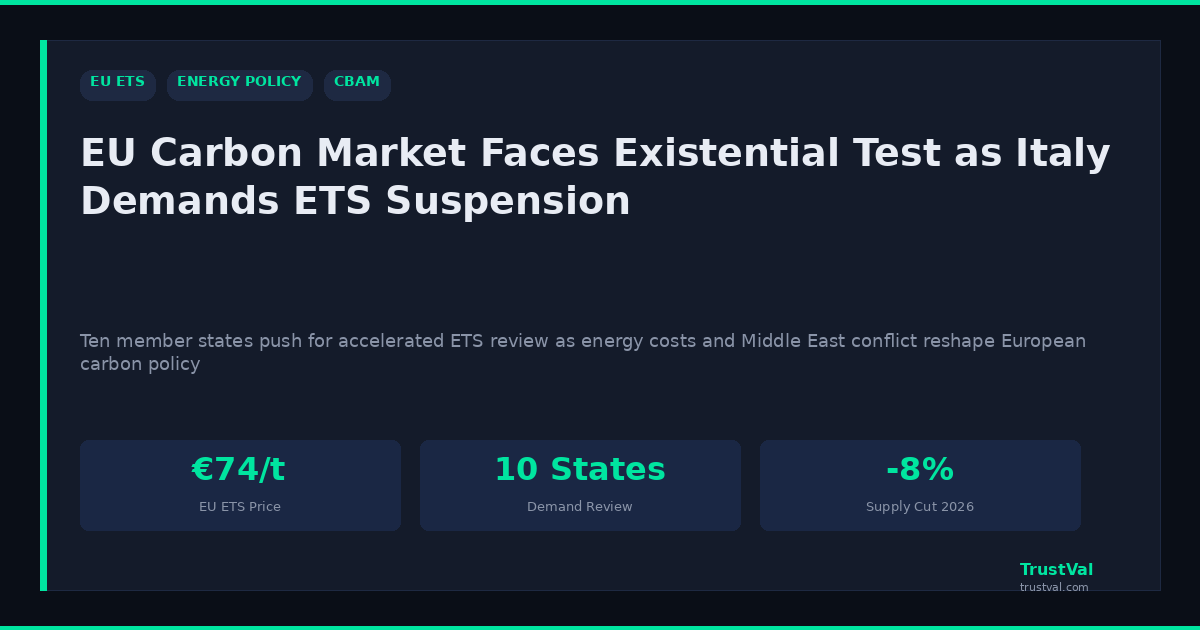
The EU Emissions Trading System faces its most serious political challenge since inception. Italy has called for a full suspension of the carbon market, while ten member states are demanding the European Commission accelerate its planned ETS review to end of May 2026 — months ahead of schedule. The push comes as the Middle East conflict drives European energy prices higher and carbon costs become a political lightning rod.
Environment ministers met on 17 March to discuss the ETS's role in a broader plan to lower energy costs. The divisions run deep. Poland and Hungary are calling for weakened emissions curbs to boost competitiveness. The Netherlands and Nordic states urge caution, arguing the ETS remains the bloc's most effective driver of clean-energy investment.
European Commission President Ursula von der Leyen is resisting calls for a full overhaul. However, the Commission is exploring targeted interventions: temporarily relaxing carbon-permit supply rules, easing conditions for granting free emissions allowances, and expanding state aid provisions for energy-intensive industries.
The political uncertainty is already priced in. EU allowances have dropped from above €90 per tonne earlier this year to around €74, reflecting market concern over potential supply-side interventions. The 2026 compliance year will see allowance supply cut by approximately 8% compared to 2025 — a mechanical tightening that should support prices if the reform framework holds.
The stakes extend beyond the ETS itself. CBAM certificate prices are directly linked to EU ETS allowance prices. Any intervention that artificially suppresses the carbon price would simultaneously reduce the CBAM levy on imports, potentially undermining the mechanism's ability to prevent carbon leakage.
The dMRV connection: Whatever form the ETS review takes, one thing is clear — more transparent, verifiable emissions data strengthens the case for maintaining carbon pricing integrity. Digital MRV infrastructure provides the granular, real-time emissions measurements that both compliance markets and voluntary buyers increasingly demand. As the political debate intensifies, the quality of underlying data becomes more important, not less.
This debate unfolds against a backdrop of converging market pressures. The CBAM authorized declarant deadline arrives on 31 March. Carbon Direct's 2026 VCM report shows buyer hesitancy holding back carbon removal scale-up. The ICVCM continues expanding quality standards for CDR credits. Each of these developments points toward a carbon market that needs more integrity, not less — even as political pressures push in the opposite direction.
For corporate buyers and project developers, the message is pragmatic: prepare for volatility, invest in data quality, and ensure your carbon strategy can withstand both a strengthened and a weakened ETS scenario. The companies that build verification infrastructure now will be best positioned regardless of which direction European policy takes.
TrustVal helps corporate buyers and project developers navigate carbon markets with confidence. Talk to our team about your carbon strategy.