
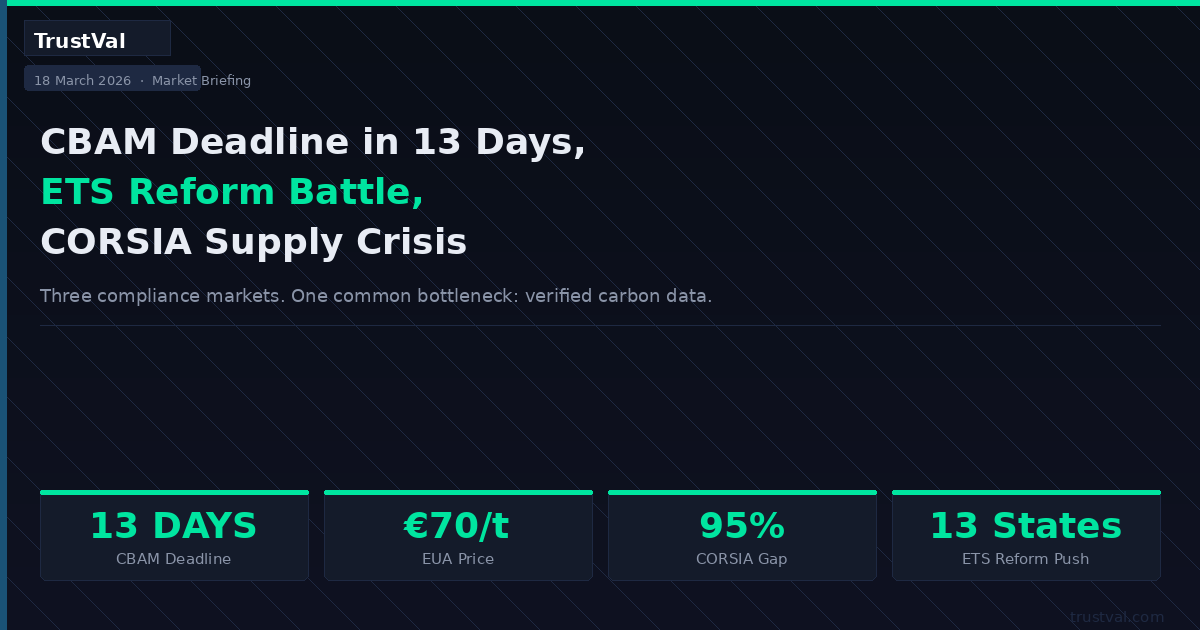
Three converging developments are reshaping the carbon compliance landscape this week. The EU's Carbon Border Adjustment Mechanism is entering its first critical enforcement moment, the EU Emissions Trading System faces its biggest political challenge in years, and the aviation sector is staring down a supply gap that threatens CORSIA Phase 1 compliance. All three stories share a common thread: the quality and credibility of carbon measurement and verification is under scrutiny like never before.
The Carbon Border Adjustment Mechanism entered its definitive phase on 1 January 2026. For the first time, EU importers bringing steel, aluminium, cement, fertilisers, electricity, or hydrogen into the EU must hold valid authorised declarant status — and the deadline to apply is 31 March 2026.
The European Commission is hosting an information session on 19 March to clarify emissions calculation methodology, verification requirements, and the accreditation process for third-party verifiers. The first quarterly CBAM certificate price will then be published on 7 April — a landmark moment for price discovery under the mechanism.
CBAM represents the most concrete application of industrial dMRV (digital Monitoring, Reporting and Verification) in the EU compliance framework. Importers need their non-EU suppliers to deploy robust measurement infrastructure, and third-party verifiers need standardised, auditable data flows to issue credible certifications.
January 2026 saw EU Allowances peak at €92 per tonne — the highest level since August 2023. The driver was structural: auction supply is set to fall from 588.7 million EUAs in 2025 to approximately 482.4 million in 2026, an 18% reduction driven by the tightening cap under Phase 4.
But prices retreated sharply to approximately €70/t in late February after 13 EU member states formally called for ETS reform. Italy, Czechia, Poland, Slovakia, France, and Belgium — each with different motivations — want changes to emission benchmarks, allowance allocation, and the timeline for phasing out free allowances under CBAM.
The ETS revision is scheduled for Q3 2026. Until then, markets will price in political uncertainty. For corporate buyers and project developers, this volatility underscores the importance of long-term strategies built on asset-level emissions data — not just carbon price speculation.
ETS2, covering road transport and buildings, remains on track to launch in 2027. Free allowances for CBAM-covered sectors will be reduced by 2.5% in 2026 and 5% in 2027, adding further pressure to sectors that have relied on free allocation.
The aviation sector faces a supply-demand crisis in CORSIA Phase 1 (2024–2026). Airlines must offset between 100 and 150 million tonnes of CO₂ equivalent by the end of 2026, but only 7.14 million CORSIA-eligible emissions units have been issued to date — a gap exceeding 95%.
New infrastructure is emerging in response. A procurement marketplace launched on 13 March 2026 specifically to help airlines source CORSIA-eligible credits. IATA is simultaneously running a Q1 2026 procurement event via the Aviation Carbon Exchange, offering one million credits from the DelAgua Rwanda Improved Cookstove Group Projects between 2 and 27 March.
Analysts at Abatable forecast that new demand for 78 million CORSIA credits will materialise just to cover 2025 emissions. This supply-demand imbalance has a direct implication for quality: when credits are scarce, buyers can — and increasingly must — insist on rigorous dMRV provenance before purchase.
Three different market mechanisms — CBAM, EU ETS, and CORSIA — are converging on the same bottleneck: the ability to measure, report, and verify carbon data at the asset level, in real time, and to a standard that withstands regulatory scrutiny.
Industrial facilities facing CBAM must retrofit their emissions infrastructure. ETS participants navigating a reform-driven price environment need granular data to optimise compliance strategies. CORSIA project developers need robust MRV to unlock the premium pricing that scarce eligible credits now command.
In each case, dMRV is not an optional upgrade — it is the foundation on which carbon market participation rests.
TrustVal helps corporate buyers and project developers build the dMRV infrastructure and carbon strategy they need to thrive in CBAM, EU ETS, and voluntary markets.
Talk to our team →