Big Tech Carbon Credit Purchases Surge 181% as AI Energy Demand Reshapes Voluntary Markets
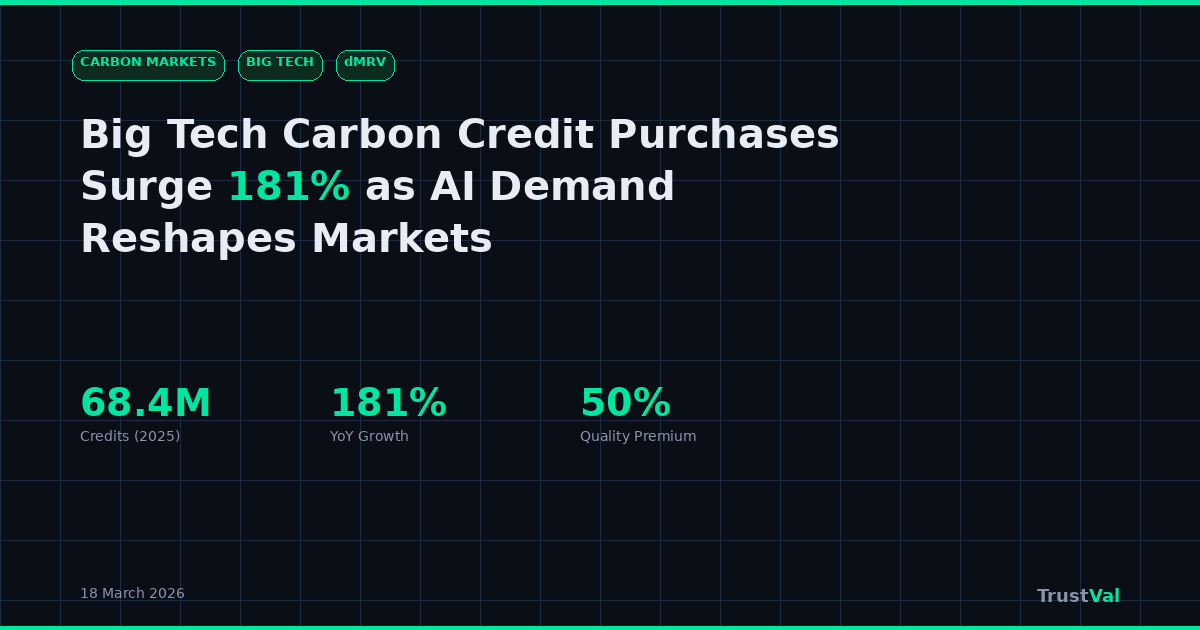
The voluntary carbon market received its strongest demand signal in history last year. Amazon, Google, Meta, and Microsoft collectively purchased 68.4 million carbon removal credits in 2025 — a staggering 181% increase from the 24.4 million credits acquired in 2024. Microsoft leads as the world's largest single corporate buyer of permanent carbon removal credits.
The catalyst behind this surge is artificial intelligence. Every major AI model requires enormous computing infrastructure, and that infrastructure consumes vast amounts of energy. Big Tech companies face a fundamental tension: they have ambitious net-zero commitments, but their fastest-growing business line — AI — is their most energy-intensive. Carbon credit procurement offers a bridge between ambition and reality.
Quality Over Quantity: The New VCM Paradigm
Tech buyers are not purchasing commodity credits. They target permanent carbon dioxide removal (CDR) credits — direct air capture with carbon storage (DACCS), biochar, enhanced weathering, and bio-oil geological storage. These categories now command prices ranging from $150 to over $500 per tonne, dwarfing the $2–5 per tonne price of generic avoidance credits.
This quality-first approach aligns with the broader VCM trend. High-integrity credits now command a 50% price premium over lower-quality alternatives, according to ClearBlue Markets. The ICVCM's Core Carbon Principles (CCPs) have become the de facto quality benchmark, with 30+ methodologies approved across nature-based, methane, and removal categories.
The implication for the carbon market ecosystem: volume without verification is increasingly worthless. Buyers demand granular, real-time measurement, reporting, and verification (MRV) data — not annual audits based on estimated baselines. Digital MRV (dMRV) is the infrastructure layer that makes this possible.
ICVCM Expands CDR Crediting Infrastructure
The supply side is responding. The ICVCM recently approved six engineered CDR methodologies, including five Isometric protocols covering biomass geological storage, bio-oil geological storage, and biogenic carbon capture and storage. Gold Standard's accelerated carbonation of concrete aggregate methodology also received CCP approval.
Together, these approved methodologies represent a pipeline of 24 projects expected to issue over 3.2 million credits annually under Isometric methods alone. While engineered CDR currently accounts for less than 1% of total VCM issuance, forward sales are growing rapidly as both the UK and EU explore integrating removal credits into compliance markets.
What This Means for Carbon Markets
The Big Tech buying spree creates three structural shifts that will define carbon markets in 2026 and beyond.
First, it validates the quality premium. When the world's most data-driven companies choose $200/tonne DACCS credits over $3/tonne avoidance credits, the market gets a clear price signal about what "quality" means.
Second, it raises the bar on measurement and verification. Tech companies operate with engineering-level data standards. They expect the same from their carbon credit suppliers. Spreadsheet-based carbon accounting cannot meet this threshold — only automated, continuous dMRV systems deliver the transparency these buyers require.
Third, it creates scarcity in the high-quality segment. With demand growing at 181% per year and CDR supply still limited, forward prices for permanent removal credits will continue rising, creating powerful incentives for project developers to invest in verifiable removal technologies.
TrustVal helps corporate buyers and project developers navigate carbon markets with confidence. Our industrial dMRV platform delivers the transparency that today's carbon market demands.