The Voluntary Carbon Market Splits: Removal Credits Command 100x Premium
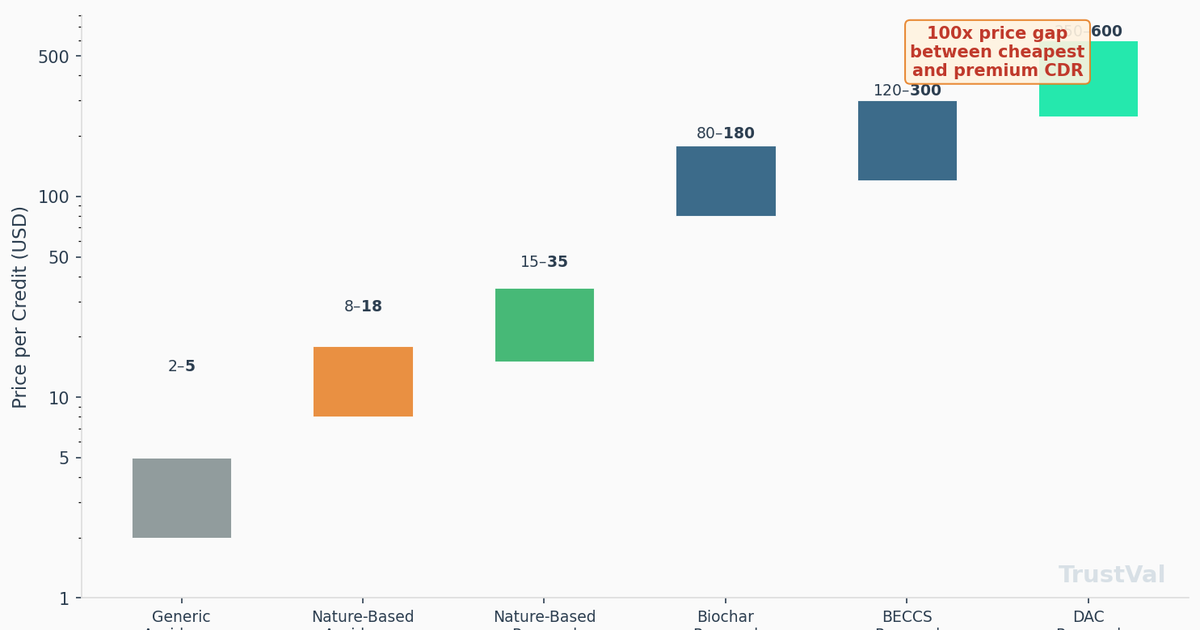
One Market Becomes Two Distinct Segments
The voluntary carbon market (VCM) is fragmenting into quality tiers with dramatic price divergence. The weighted average spot price of $5.6 per credit masks extraordinary variation within the market.
Generic avoidance credits trade below $5 per metric ton of CO₂. Nature-based removal credits command $15-35/t. Technology-based carbon dioxide removal (CDR) credits reach $150-600/t depending on permanence and verification rigor.
This price spectrum reflects market participants recognizing fundamental differences in credit quality. Cheap avoidance credits offer minimal climate impact assurance. Premium removal credits provide durable, measurable atmospheric carbon reduction.
The VCM projects growth to $1.7 billion in 2026, with acceleration to $47.5 billion by 2035. However, this aggregate growth masks divergent trajectories within the market. Avoidance credits face margin pressure. CDR credits command increasing premiums.
Direct Air Capture Commands Price Leadership
Direct air capture (DAC) represents the frontier of CDR technology. DAC credits range from $125 to $1,000 per metric ton depending on storage permanence and verification methodology.
Permanence drives pricing power in DAC markets. Credits backed by 10,000-year geological storage command higher prices than those relying on shorter-term mineralization pathways. Investors differentiate strictly between permanence assumptions.
Technology-based CDR currently represents only 6% of all VCM credits traded. Nature-based removal—including reforestation and soil carbon—comprises 95% of CDR credit supply. This supply concentration reflects cost economics and deployment speed advantages for natural pathways.
Large Emitters Drive Quality Demand
Microsoft leads corporate procurement of durable CDR credits for climate commitments. The technology company targets permanent removals aligned with net-zero targets. Microsoft's purchasing preferences influence emerging market standards.
World Bank analysis reveals bifurcated corporate behavior. Large multinational emitters reduce real operational emissions while procuring high-quality CDR credits. Smaller companies disproportionately purchase cheap avoidance credits that deliver minimal climate impact.
This divergence reflects risk management differentiation. Large corporations face regulatory scrutiny and stakeholder oversight of climate claims. Cheap credits create credibility risk. High-quality credits support marketing and regulatory positioning.
Smaller firms operate under different incentive structures. Regulatory pressure remains minimal in many jurisdictions. Cost minimization dominates purchasing decisions over credit quality verification.
Market Segmentation Accelerates
The VCM increasingly fragments into distinct product categories with separate pricing mechanisms. Premium removal credits trade among sophisticated institutional buyers focused on durability. Commodity avoidance credits serve compliance-driven purchasers accepting lower environmental integrity.
Third-party certification becomes increasingly critical as prices diverge. Rigorous methodology standards differentiate premium credits from commodity supply. Buyers willing to pay $300-600/t for DAC credits demand transparent permanence guarantees and geological storage verification.
Marketplace consolidation follows these quality dynamics. Premium CDR platforms serve institutional allocators. Commodity spot markets serve price-sensitive corporate buyers. The integrated VCM concept dissolves into separate markets.
Nature-Based Removal Supplies Most Carbon Reduction
Despite lower unit prices, nature-based removal credits dominate VCM supply volume. Reforestation programs and soil carbon initiatives provide cost-effective removal pathways. Permanence risks remain material but deployment capacity exceeds technology-based CDR by orders of magnitude.
Biochar emerges as hybrid category between technology and nature-based removal. Biochar credits trade at $200-400/t reflecting permanence advantages over conventional nature-based approaches. Supply growth accelerates as pyrolysis technology deployment expands.
Cost curves favor nature-based removal through 2030. Scalable reforestation projects deliver carbon reduction at $5-20/t including project development costs. Technology-based CDR cost curves decline slowly from current $200-600/t baseline.
Credit Sourcing Demands Institutional Rigor
Market participants cannot treat VCM credit sourcing as commodity procurement. The quality spectrum demands differentiated due diligence workflows. Institutional buyers conduct pre-purchase verification of additionality, permanence, and methodology rigor.
Supply concentration creates additional risk. Few providers deliver truly high-quality CDR credits at scale. Buyers securing premium credit supply often execute multi-year forward contracts. Spot market pricing premiums reflect scarcity of high-quality supply.
Credit sourcing strategy directly impacts climate commitments. Cheap avoidance credits create net-zero claims that skeptical observers readily dismiss. High-quality CDR credits provide defensible environmental integrity supporting corporate climate positioning.
The VCM bifurcation accelerates corporate climate accountability. Quality divergence makes credential skepticism increasingly rational. Transparent, rigorous carbon credit sourcing becomes competitive advantage in climate-conscious markets.
Sources
Navigate VCM Bifurcation with Confidence
TrustVal tracks voluntary carbon market pricing, quality metrics, and provider benchmarking. Understand credit permanence assumptions and technology cost trajectories.
Access TrustVal's VCM Intelligence Platform for real-time pricing data, supplier ratings, and methodology risk assessment across avoidance and CDR credit categories.