EU Carbon Removal Certification Framework Launches: dMRV Becomes Essential Infrastructure
Government-Backed Carbon Removal Arrives
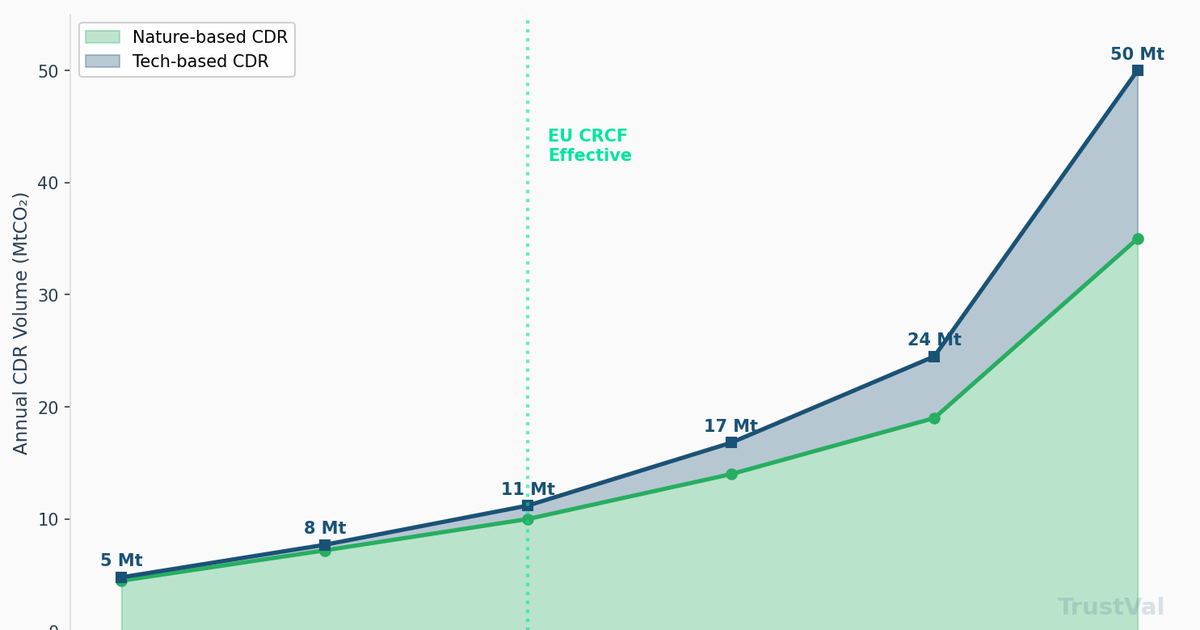
The EU Carbon Removal Certification Framework (CRCF) becomes effective in 2026. This framework represents the first government-backed carbon removal certification standard globally. The CRCF establishes EU-wide standards for certifying legitimate carbon dioxide removal from atmosphere.
CRCF launches with explicit quality assurance focus. The framework demands rigorous verification of removal permanence, additionality, and environmental integrity. This government backing lends market credibility absent from voluntary market alternatives.
The framework applies to both nature-based removals and technological CDR pathways. Reforestation, soil carbon, biochar, direct air capture, and other removal methodologies undergo standardized assessment. Certified removals receive official EU recognition supporting future ETS eligibility decisions.
This certification represents strategic policy infrastructure. EU regulators anticipate CRCF-certified removals eventually merging into the Emissions Trading System (ETS). Legal framework for ETS integration remains under 2026 regulatory review with decision expected later this year.
Digital Monitoring Replaces Manual Audits
CRCF infrastructure mandates digital Monitoring, Reporting, and Verification (dMRV) systems replacing traditional manual audit approaches. dMRV enables real-time emissions tracking and removal verification using connected sensors and data systems.
Technology-based CDR projects benefit most immediately from dMRV infrastructure. Direct air capture facilities deploy continuous monitoring of feedstock carbon, compression energy inputs, and storage outcomes. Real-time data transmission eliminates annual audit delays.
Nature-based removal projects implement dMRV through satellite monitoring, soil carbon sensors, and vegetation imaging systems. Remote sensing provides scalable carbon accounting for forest carbon and agricultural soil projects. Ground truthing augments satellite data maintaining verification rigor.
dMRV systems demand significant capital investment and technical expertise. Third-party dMRV providers emerge as essential infrastructure specialists. Companies offering dMRV solutions experience rapid demand growth as CRCF implementation accelerates.
ETS Integration Could Reset Carbon Pricing
EU policymakers consider integrating CRCF-certified removals directly into the ETS mechanism. This decision review occurs throughout 2026. BloombergNEF modeling suggests ETS inclusion could lower carbon prices 4-7% by 2035 as removal supply constrains abatement demand.
Removal supply constraints limit potential ETS price depression. Most permanent CDR supply through 2030 remains pre-contracted by Microsoft, other technology companies, and aviation sector participants. CORSIA (the international aviation carbon offset program) already traded 32 million credits with prices at lowest levels in a year.
ETS integration would create dual-track compliance pathways. Industrial emitters could either reduce emissions or retire CRCF-certified removals against ETS obligations. This choice mechanism potentially increases compliance flexibility while ensuring climate integrity through removal permanence standards.
Carbon price impacts depend fundamentally on removal supply growth rates. If CDR capacity scales faster than ETS modeling assumes, price pressure accelerates. Current technology cost trajectories suggest material scale-up through 2030 remains constrained by capital availability and technology maturity.
Pre-Contracted Supply Dominates Through 2030
Removal project developers already committed approximately 90% of projected CDR supply through 2030 to long-term contracts. Microsoft, other technology companies, and aviation operators secured durable removal capacity years in advance of CRCF launch.
This supply contraction creates market structure implications. Spot market removal pricing rises as demand grows while contracted supply absorbs incremental buyers. New emitters entering removal markets encounter tight supply and premium pricing for available capacity.
Project developers face conflicting incentives. Long-term contracts lock in pricing early before technology cost reductions fully materialize. Spot market sales capture current premium pricing. Risk-averse developers prefer contract certainty. Optimistic operators hold inventory seeking spot market appreciation.
Permanence Standards Drive Technology Selection
CRCF permanence requirements directly influence technology deployment decisions. Geological sequestration via direct air capture meets the strictest permanence standards at 10,000+ year timeframes. Nature-based removals face greater permanence uncertainty due to fire, pest, and climate risks.
EU policymakers emphasize permanence in CRCF standard-setting. This emphasis favors technology-based approaches despite cost disadvantages versus natural removals. Regulatory preference for geological storage creates investment incentives redirecting capital toward DAC and point-source sequestration solutions.
Biochar emerges as compromise technology. Biochar permanence reaches centuries-to-millennia timescales depending on storage conditions. Biochar deployment accelerates as operators seek permanence standards satisfying regulatory requirements while achieving cost economics superior to direct air capture.
Competitive Advantage Through dMRV Leadership
Companies establishing dMRV expertise capture disproportionate value capture as CRCF implementation proceeds. Removal project operators select dMRV providers offering proven performance, regulatory alignment, and real-time data integration capabilities.
Early dMRV adoption provides competitive advantages through data quality and regulatory credibility. Projects deploying advanced dMRV systems receive CRCF certification faster than those relying on traditional audit approaches. Time-to-market advantages matter enormously for removal projects seeking premium removal pricing.
Software platforms integrating dMRV data with carbon credit issuance and retirement systems become strategic infrastructure. Vendors controlling these integration points establish network effects protecting market position against competitive entrants.
The EU Carbon Removal Certification Framework fundamentally reshapes removal markets through dMRV infrastructure requirements and permanence emphasis. Early infrastructure investments capture outsized returns. Removal project operators leveraging dMRV technology advance regulatory timelines and maximize revenue capture. ETS integration decisions later this year could amplify these dynamics dramatically.
Sources
Monitor EU Carbon Removal Policy in Real Time
TrustVal tracks CRCF implementation progress, dMRV provider benchmarking, and ETS integration decision timelines. Stay updated on removal technology cost curves and permanence standard developments.
Join TrustVal's EU Carbon Policy Intelligence Stream for daily monitoring of CRCF regulatory guidance, removal project certifications, and permanence standard refinements as EU infrastructure scales.