India's Carbon Market Goes Live: 700 Million Tonnes and 9 Sectors Enter Compliance Trading
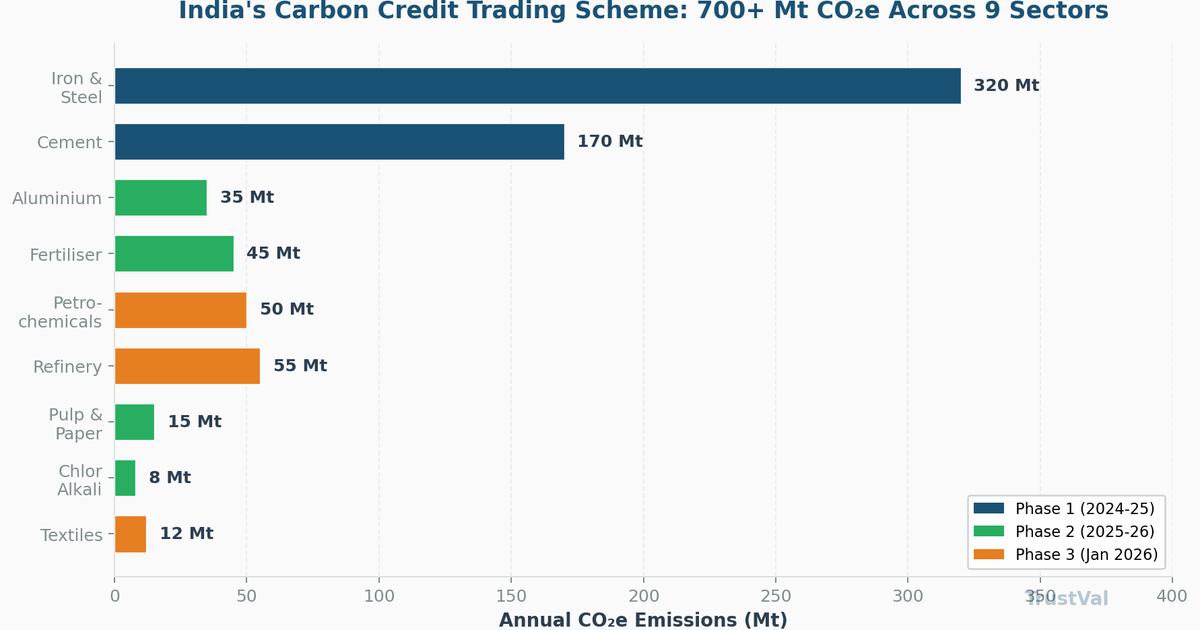
India's Carbon Credit Trading Scheme (CCTS) moves toward its full operational launch by mid-2026, creating one of the world's largest emissions trading systems overnight. The scheme covers more than 700 million tonnes of CO₂e across nine energy-intensive industrial sectors — a scope that rivals the EU ETS in absolute emissions coverage.
The Ministry of Environment notified final emission intensity targets for the last three sectors — Refinery, Petrochemicals, and Textiles — on January 16, 2026. With all nine sectors now carrying binding targets, the compliance mechanism enters its final pre-launch phase. Trading will occur through India's existing power exchanges under oversight from the Central Electricity Regulatory Commission.
Nine Sectors, One System
The CCTS takes an intensity-based approach rather than setting absolute emission caps. Each covered entity receives a greenhouse gas emission intensity target per unit of output. Companies that beat their target generate tradeable carbon credit certificates (CCCs). Those that miss their target must purchase CCCs to cover the shortfall.
Iron and steel dominate the scheme's coverage at roughly 320 million tonnes annually. Cement follows at 170 million tonnes. The remaining seven sectors — aluminium, fertiliser, petrochemicals, refinery, pulp and paper, chlor alkali, and textiles — account for the balance. The government plans to add more sectors in future phases.
Architecture and Governance
Three government bodies jointly manage the CCTS. The Ministry of Power sets the policy framework. The Ministry of Environment, Forest and Climate Change (MoEFCC) defines emission targets. The Bureau of Energy Efficiency (BEE) serves as day-to-day administrator, handling registration, monitoring, and credit issuance.
Carbon credit certificates trade on India's two power exchanges — IEX and PXIL — providing liquid, transparent price discovery. The CERC provides market oversight and holds authority to intervene against manipulation or fraud. This exchange-based model mirrors successful commodity trading infrastructure already familiar to Indian industry.
Global Implications
India's CCTS launch reshapes global carbon market dynamics in three ways. First, the sheer scale — 700+ million tonnes — adds significant compliance demand to the worldwide carbon pricing landscape. Second, the intensity-based design creates a model for other developing economies that want carbon pricing without absolute caps. Third, the voluntary offset mechanism for agriculture opens a massive new credit supply source.
The timing matters. India's system launches as the EU's CBAM creates growing pressure on exporting nations to implement domestic carbon pricing. Indian steel and aluminium producers who demonstrate robust domestic carbon pricing may eventually qualify for CBAM deductions on their EU exports, providing a direct financial incentive for the system's success.
What Businesses Should Watch
Companies with operations or supply chains in India face a new variable in their cost structure. The initial CCC price remains unknown — market forces will determine it once trading begins. Analysts expect modest prices initially, with upward pressure building as intensity targets tighten in subsequent compliance periods.
For carbon market participants outside India, the CCTS creates both opportunity and competition. Project developers may find new revenue streams in Indian offset projects. Credit buyers gain access to a large new supply pool, though interoperability between Indian CCCs and international standards remains undefined.
TrustVal helps corporate buyers and project developers navigate carbon markets with confidence. Our team tracks emerging compliance markets, evaluates cross-border carbon pricing impacts, and structures strategies for multi-jurisdiction exposure. Talk to our team about your carbon strategy.
TrustVal provides carbon market advisory and valuation services. For more information, visit trustval.com.