EU Announces First CBAM Certificate Price Publication for April 7
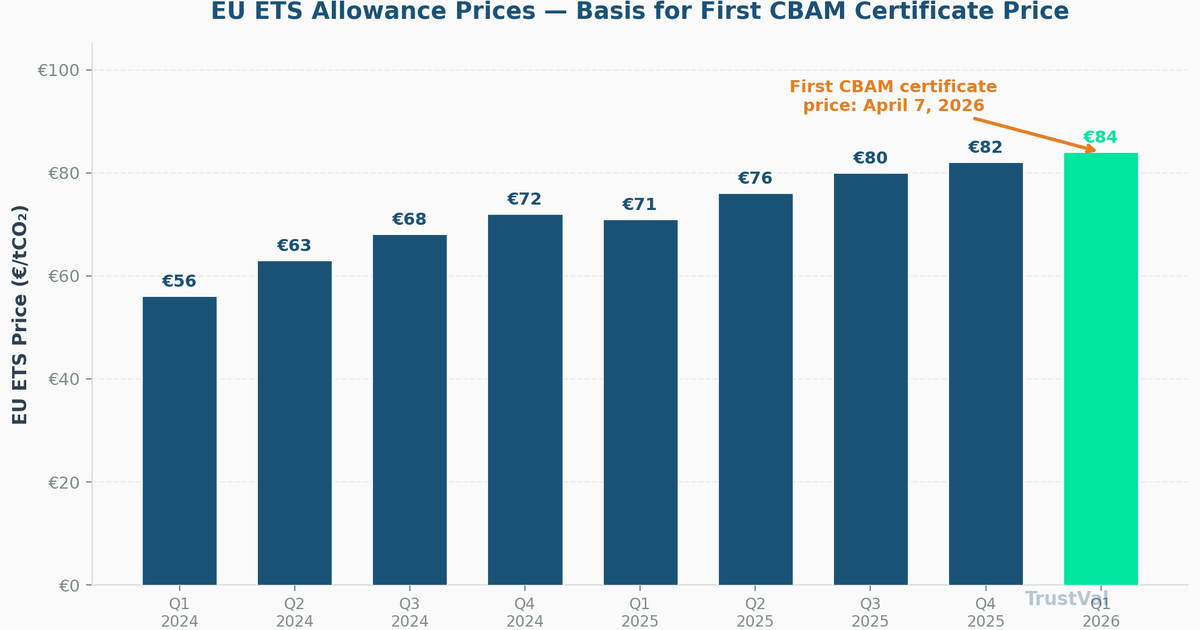
The European Commission confirmed on March 6 that the first official CBAM certificate price will appear on April 7, 2026. This price will reflect the quarterly average of EU ETS auction clearing prices from Q1 2026 and will set the benchmark for every CBAM certificate purchased throughout the compliance year.
The announcement marks a tangible milestone. After three years of transitional reporting and months of operational setup, importers of carbon-intensive goods now face a concrete price signal tied directly to the EU's carbon market. The publication will appear simultaneously on the Commission's CBAM webpage and in the CBAM Registry.
How Certificate Pricing Works
CBAM certificate prices mirror the EU ETS. Each quarter, the Commission calculates the average auction clearing price of EU Allowances (EUAs) and sets the CBAM certificate price accordingly. With EUAs currently trading around €84 per tonne of CO₂, importers should expect Q1 2026 certificates to land in a similar range.
The pricing mechanism creates direct parity between domestic EU producers — who buy ETS allowances — and foreign producers importing into the EU. This closes the carbon leakage gap that CBAM targets. Importers who can demonstrate that their country of origin already charges a carbon price receive a deduction on their CBAM obligations.
Common Central Platform Tender Closes March 20
The Commission launched a call for tenders to build the Common Central Platform — the system that will manage all CBAM certificate transactions. Offers close on March 20, 2026. This platform will handle certificate purchases, repurchases, and surrenders across all 27 Member States.
The platform's design carries strategic weight. It must process transactions for over 12,000 authorized declarants, handle cross-border emission calculations, and integrate with national customs systems. The tight timeline between the March 20 tender deadline and the February 2027 sales launch leaves just 11 months for development, testing, and deployment.
Free Allowance Phase-Out Accelerates
CBAM's pricing pressure intensifies as free ETS allowances shrink. In 2026, free allocations for CBAM-covered sectors drop by 2.5%. In 2027, the cut doubles to 5%. By 2034, free allowances disappear entirely. The European Commission estimates this adds approximately €1 per tonne of CO₂ in 2026 and €2 in 2027 to industry's effective carbon costs.
These numbers look modest in isolation. The compounding effect tells a different story. As free allocations decline, the financial gap between decarbonized and carbon-intensive production widens each year. Companies that invest in emission reductions now lock in a growing competitive advantage.
What Importers Must Do Now
Three actions demand immediate attention. First, verify your authorized declarant status — the Commission approved 4,100 declarants in the first wave, with more applications under review. Second, map your supply chain's embedded emissions with precision, since CBAM certificate costs scale directly with emission intensity. Third, model your financial exposure using the €84 benchmark and plan for certificate purchases opening in February 2027.
Companies importing aluminium, cement, electricity, fertilizers, iron and steel, or hydrogen face the most urgent timeline. The Commission's proposed expansion to 180 downstream products means manufacturers of finished goods containing these materials should begin preparation now.
TrustVal helps corporate buyers and project developers navigate carbon markets with confidence. Our team provides CBAM compliance support, emission mapping, and carbon cost modelling. Talk to our team about your carbon strategy.
TrustVal provides carbon market advisory and valuation services. For more information, visit trustval.com.