The 300% Quality Gap: How Carbon Credit Pricing Splits the Voluntary Market in 2026
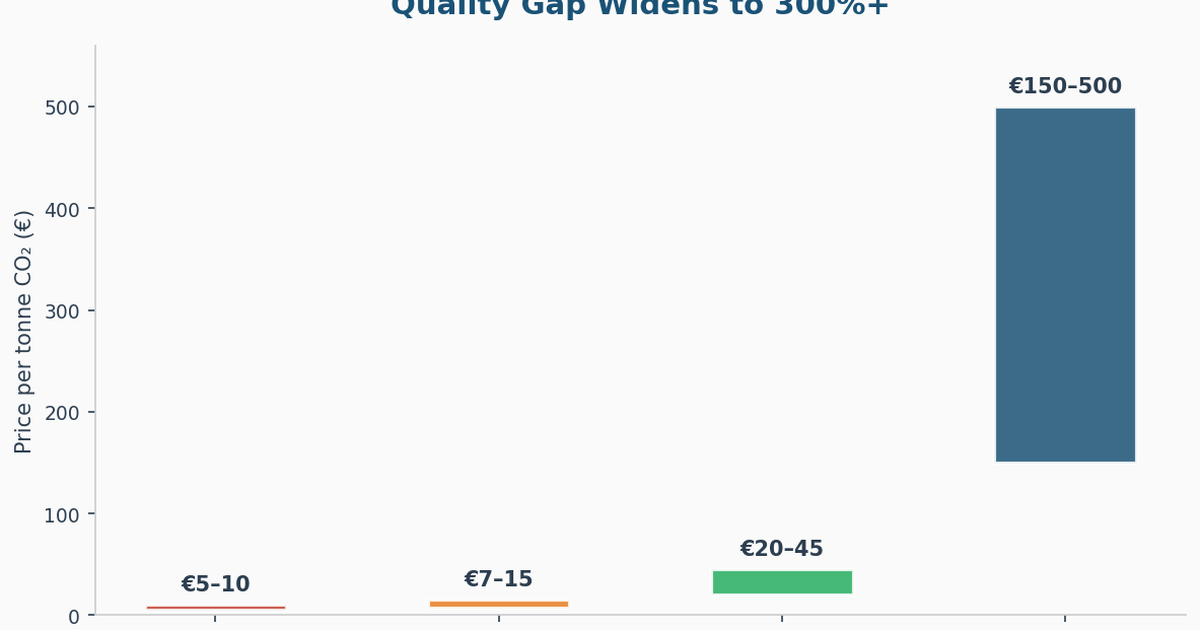
A carbon credit is no longer just a carbon credit. In 2026, the voluntary carbon market splits into clearly defined quality tiers, each with dramatically different price tags. High-integrity credits now command premiums of 300% or more over their low-quality counterparts. This price divergence reflects a market that finally rewards quality over quantity.
The numbers tell the story. Low-quality avoidance credits trade between €5 and €10 per tonne. Standard nature-based offsets sit in the €7-15 range. High-integrity nature-based credits with rigorous additionality evidence fetch €20-45. Technology-based carbon dioxide removal (CDR) commands €150-500 per tonne. The days of treating all credits as interchangeable ended.
From Hype to Professionalization
The voluntary carbon market followed a predictable arc. The 2021-2023 period brought hype and backlash. The 2024-2025 years delivered an integrity reset. Now 2026 marks the professionalization phase: more data, tighter regulation, and clearer segmentation between asset classes.
The market reached approximately €2.5 billion in value in 2025, with projections pointing to €3 billion in 2026. Growth forecasts suggest €15 billion by 2035, driven by the convergence of voluntary and compliance demand. MSCI Carbon Markets projects even higher ceilings: USD 7-35 billion by 2030.
ICVCM Core Carbon Principles Reshape Demand
The Integrity Council for the Voluntary Carbon Market (ICVCM) now shapes buyer expectations directly. CCP-tagged retirements more than doubled in 2025, rising from 3% to 7% of total retirements. But supply remains tight. Only 51 million credits held CCP approval by December 2025, representing just 4% of 2024 issuance.
Article 6 Creates a Two-Tier Market
The operationalization of Article 6 of the Paris Agreement adds another dimension. Authorized credits — Internationally Transferred Mitigation Outcomes (ITMOs) — carry a Letter of Authorization from the host country and command significantly higher prices. Non-authorized credits remain available for voluntary corporate contribution claims but trade at a growing discount.
This two-tier structure matters because CORSIA, the aviation sector's offsetting mechanism, requires authorized credits. With 146-236 million units of projected demand in the 2024-2026 phase and $1.7 billion in compliance costs for airlines in 2026 alone, the authorized credit market attracts institutional-grade capital.
Compliance and Voluntary Markets Converge
Compliance programs now account for 24% of total credit demand, up from negligible levels just years ago. The EU's Green Claims Directive, taking effect in September 2026, bans generic carbon-neutral claims based solely on offsets. Fines reach up to 4% of annual EU turnover. This regulatory pressure pushes companies toward higher-quality credits and deeper decarbonization.
SBTi's revised Corporate Net Zero Standard V2.0 clarifies procurement expectations for over 10,000 signed-up companies. Decisions on including CDR in the UK's Sustainable Aviation Fuel mandate could create the first large-scale compliance demand for removal credits.
Asia-Pacific Emerges as Growth Engine
Asia-Pacific positions itself as the VCM's centre of gravity. Forecasts suggest the region could grow at a 36-58% compound annual growth rate, outpacing every other geography. China leads through massive renewable deployment and methane initiatives. This geographic shift creates new opportunities for project developers and buyers willing to navigate diverse regulatory environments.
What Buyers Should Do Now
The quality gap will widen further. Corporate buyers who wait to build carbon credit portfolios face higher costs and tighter supply for the credits that matter. Three actions make sense today: first, audit existing credit holdings against CCP and ICROA standards. Second, secure forward contracts for high-integrity credits before prices climb further. Third, build a diversified portfolio across credit types and geographies, with a growing allocation to CDR.
Sources
TrustVal helps corporate buyers and project developers navigate carbon markets with confidence. Talk to our team about your carbon strategy.
TrustVal provides carbon market advisory and valuation services. For more information, visit trustval.com.