Verra Approves First dMRV Carbon Credits: Digital Verification Goes Live
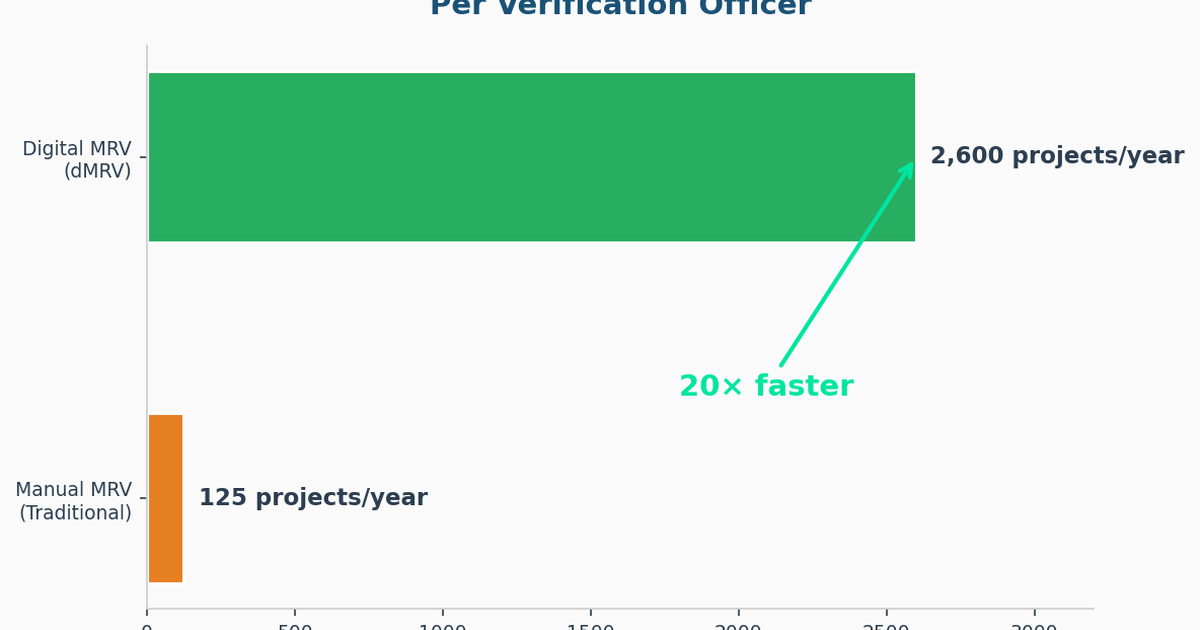
Verra just approved the first carbon credits generated through its digital Monitoring, Reporting, and Verification (dMRV) pilot. The Foumbouni-Mitsamiouli solar farm on Grande Comore in the Comoros became the inaugural project, with SustainCERT conducting an entirely digital verification. This milestone marks the beginning of a fundamental shift in how carbon markets operate.
Under the manual verification model, one verification officer processes 100-150 projects per year. Digital MRV changes that equation entirely. One officer can now verify 10 projects per day, multiplying capacity by a factor of 20. The pilot enables monthly or bi-monthly credit issuances instead of the traditional annual cycle, giving project developers faster access to revenue.
How the Pilot Works
Project developers submit monitoring data electronically. Verification bodies conduct the entire review process online. No physical site visits needed for the initial assessment. Verra withholds 20% of issued credits as a safeguard during the pilot period. The process leverages IoT sensors, AI-based analysis, and blockchain-backed data integrity to replace manual spreadsheet reviews with automated, tamper-proof verification.
Verra now pilots dMRV-based issuances for additional project types beyond solar, including carbon capture and storage (CCS) and clean cookstove projects. Gold Standard runs its own pilot through October 2026. The Global Carbon Council launched a public consultation on its Energy Access Program Validation and Verification Standard, built entirely around digital MRV.
Why This Matters for Carbon Market Scale
The carbon market faces a bottleneck. Demand for high-quality credits outpaces the market's ability to verify and issue them. Manual verification processes take 6-18 months. Project developers wait years for their first credit issuance. This delays revenue, discourages investment, and constrains the supply of verified credits.
Regulatory Alignment
dMRV aligns with emerging regulatory frameworks. The EU's Carbon Removal Certification Framework (CRCF), launching in 2026, positions digital verification as a foundation for high-quality government removal policy. Future ETS integrations in the EU, UK, and Japan will require the kind of continuous, automated monitoring that dMRV delivers.
The convergence of compliance and voluntary markets amplifies this need. As CORSIA demands authorized credits and national ETS programs explore credit integration, the verification infrastructure must scale to handle exponentially more projects without sacrificing accuracy.
The Technology Stack
Modern dMRV platforms combine several technologies. IoT sensors collect real-time emissions and generation data. Satellite imagery verifies land-use claims. AI algorithms detect anomalies and validate monitoring reports. Blockchain provides an immutable audit trail. Together, these tools replace subjective human judgment with transparent, repeatable, data-driven verification.
The shift also democratizes access. Smaller projects in developing countries, which previously could not afford traditional verification costs, can now participate in carbon markets. This opens new supply from regions where emission reductions and removals deliver the highest impact per dollar invested.
What Comes Next
Verra will expand the dMRV pilot to more project types and geographies throughout 2026. Gold Standard's pilot results arrive in October. Expect the major registries to formalize dMRV pathways into their standard operating procedures by 2027. For project developers and technology providers, the window to build dMRV capacity is now.
Sources
TrustVal builds industrial dMRV technology for carbon credit verification. Our platform helps project developers achieve faster issuance with higher integrity. Talk to our team about digital verification.
TrustVal provides carbon market advisory and valuation services. For more information, visit trustval.com.