Washington, California and Quebec Move to Create North America's Largest Carbon Market
On March 3, 2026, Washington State released a draft linkage agreement that would merge its cap-and-trade program with the existing linked markets of California and Quebec. If approved, this would create North America's largest carbon market by coverage, spanning three jurisdictions and cutting across 800 million tonnes of annual emissions.
The linkage represents a fundamental shift in North American climate policy. Rather than operating in isolation, Washington's Climate Commitment Act program would harmonize with California's cap-and-trade system and Quebec's Emissions Trading System, creating a single, integrated carbon market. For businesses, investors, and carbon market participants, this signals both opportunity and complexity.
The Price Convergence Problem
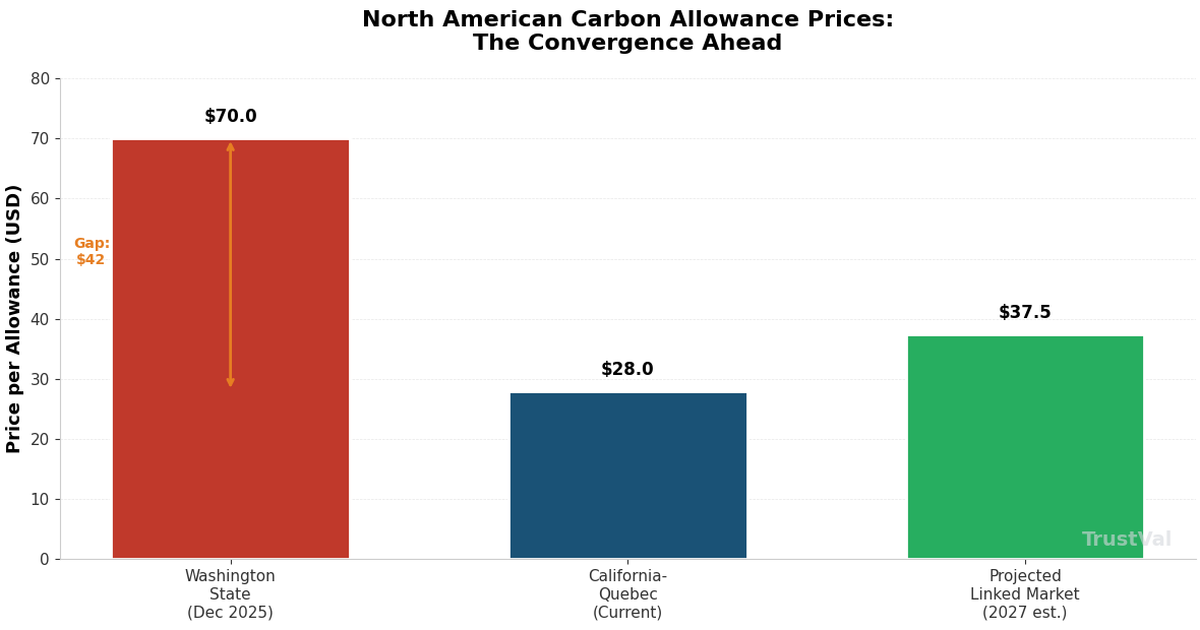
Washington's Climate Commitment Act cap-and-trade program has operated independently since 2023, and prices have diverged sharply from California and Quebec. In December 2025, Washington allowances traded around $70 per tonne — more than double the price of California and Quebec allowances, which hovered under $30 per tonne.
This price gap creates a competitive disadvantage for Washington-based businesses. Companies subject to the program face higher compliance costs than their counterparts in California and Quebec. The draft linkage agreement would resolve this disparity by allowing allowances from any jurisdiction to be used by regulated entities in any other jurisdiction. Over time, prices would converge to reflect the true marginal cost of abatement across the combined market.
The link would operate through joint auctions, where allowances from all three jurisdictions would be offered simultaneously. This deepens the market, improves price discovery, and eliminates the incentive for allowances to trade at a premium in one jurisdiction while discounted in another.
Market Integration Reality: In a linked market, businesses no longer optimize for jurisdiction-specific allowance costs. Instead, they optimize for total compliance burden across the entire region. This drives more efficient decarbonization by directing capital toward the lowest-cost emissions reductions, regardless of location.
Timeline and Regulatory Pathways
The public comment period for Washington's draft linkage agreement opened immediately upon release and will remain open until May 1, 2026. Public hearings are scheduled for April 22 and April 27, 2026, giving stakeholders multiple opportunities to weigh in on the proposal.
If approved, the linked market could begin operating as early as 2027. However, several regulatory hurdles must be cleared first. Washington must complete a comprehensive Environmental Justice Assessment, as required under the Climate Commitment Act. Additionally, California and Quebec will need to formally approve the linkage through their own regulatory processes.
The timing is significant. The three jurisdictions have spent the past several years operating independent programs, accumulating experience with their respective design elements. Linkage would force a reconciliation of these design differences — allowance banking rules, price floors and ceilings, offset usage, and reserve policies would all need to be harmonized or bridged.
Environmental Justice and Distributional Impacts
One of the more contentious aspects of linkage will be managing distributional equity. Washington's Climate Commitment Act includes specific provisions requiring that at least 25% of program revenues support climate and energy justice investments in vulnerable communities. When linked to California's program, Washington will need to ensure that price convergence — which may reduce overall compliance costs — does not erode the financial commitment to environmental justice.
Similarly, California and Quebec will want assurances that linkage with Washington does not dilute the environmental integrity or equity provisions embedded in their own programs. The draft agreement will need to specify how revenue allocation, offset usage, and compliance flexibility will be managed in a way that maintains each jurisdiction's environmental and social commitments.
Allowance Dynamics and Market Mechanisms
Under linkage, Washington's excess allowance supply — the program currently has a price floor of $59 per tonne and has generated substantial allowance inventories — would flow into California and Quebec markets, helping moderate prices in those jurisdictions. Conversely, if California and Quebec face tighter supply, Washington allowances would clear at prices closer to the linked-market equilibrium.
The draft agreement will specify rules around price floors and ceilings. Washington's current floor is $59; California and Quebec have more complex price support systems. One of the core technical challenges of linkage is deciding whether prices should be allowed to converge freely or whether jurisdictions should maintain independent price floors and ceilings. Each approach has trade-offs.
Offset usage is another critical question. Washington's program allows the use of international offset credits; California's does not. Linkage will require clarity on whether offsets sourced under Washington's rules can be used for compliance by entities in California and Quebec. Any asymmetry here creates arbitrage opportunities and could trigger legal challenges.
Compliance Planning Opportunity: For corporate buyers subject to any of these three programs, linkage creates a multi-year window to reassess compliance strategy. Companies can lock in current prices through forward contracts before linkage closes the price gap, or they can position their procurement strategies to benefit from anticipated price convergence.
Implications for Compliance Planning
For companies with operations across Washington, California, and Quebec, the prospect of linkage simplifies compliance planning. Instead of managing three distinct allowance portfolios, businesses could optimize across a single, larger market. However, the transition period — between now and 2027 — creates planning complexity.
Regulated entities must decide whether to accelerate compliance activities in 2026 to lock in Washington's higher allowance prices before convergence, or to defer and benefit from anticipated price declines in 2027. This is not a trivial decision for companies with large compliance obligations.
Additionally, linkage creates incentives for companies to invest in early decarbonization. The temporary price differential means that reductions undertaken in Washington today, before linkage, have higher carbon credit value than reductions undertaken after linkage is operational. This could accelerate investments in energy efficiency, renewable energy procurement, and emissions reduction projects across the region.
Cross-Border Investment Signals
Linkage also signals to investors that North American carbon markets are consolidating around larger, more liquid platforms. This has ripple effects for the voluntary carbon market, offset pricing, and international linkage discussions. If Washington's linkage with California and Quebec succeeds, it sets a template for other regions considering market integration.
The ICAO's Carbon Offsetting and Reduction Scheme for International Aviation (CORSIA) and various international carbon border adjustment mechanisms — including the EU's CBAM — all interact with domestic and regional carbon markets. A larger, more liquid linked market in North America could become a key reference point for international climate finance and compliance planning.
TrustVal's Perspective
At TrustVal, we view Washington's linkage proposal as a watershed moment for North American carbon market maturity. The proposal demonstrates that subnational carbon markets have evolved beyond small-scale pilot programs into systems sophisticated enough to be bridged and unified.
Market linkage creates complexity, but it also creates clarity. Companies operating across multiple jurisdictions gain a single, unified pricing signal. Compliance costs become more predictable. And the broader decarbonization incentive — to invest in the lowest-cost emissions reductions regardless of geography — becomes stronger.
The key challenge for stakeholders now is to engage meaningfully during the public comment period and the regulatory review process. The details matter tremendously: price floors, offset eligibility, revenue allocation, and banking rules will determine whether linkage actually delivers the benefits of market integration or simply creates arbitrage opportunities and regulatory friction.
For corporate buyers and project developers, the message is clear: pay attention to the linkage timeline. The 2026-2027 window presents a unique opportunity to optimize compliance strategies in anticipation of market integration. And for those developing carbon reduction projects in the region, the impending linkage signals that allowance prices will likely decline toward a regional equilibrium — making project economics increasingly dependent on co-benefits, voluntary credits, and long-term contracting strategies.
TrustVal helps corporate buyers and project developers navigate carbon markets with confidence. Talk to our team about your carbon strategy.