EU Bans 'Climate Neutral' Product Claims Based on Offsets — Starting September 2026
The European Union's Empowering Consumers for the Green Transition Directive (Directive 2024/825), also known as the Greenwashing Directive, is about to reshape how companies communicate about carbon offsetting. Starting September 27, 2026, companies in the EU market can no longer claim that a product is "climate neutral," "CO2 neutral," or similar phrases if those claims rely on carbon offsets.
This is not a minor labeling change. The ban eliminates the primary marketing mechanism through which the voluntary carbon market has attracted corporate demand. For the past decade, carbon offsets have been sold largely as a way for companies to offset their emissions and make headline claims about being carbon neutral. That era is ending.
For corporate carbon buyers, offset providers, and the voluntary carbon credit market broadly, the directive represents a fundamental reorientation. Offsets will no longer be marketed as a pathway to achieve "climate neutral" status. Instead, they will be relegated to a supporting role in decarbonization strategies — valuable for addressing residual, hard-to-abate emissions after companies have genuinely reduced their own emissions.
The Scope of the Ban
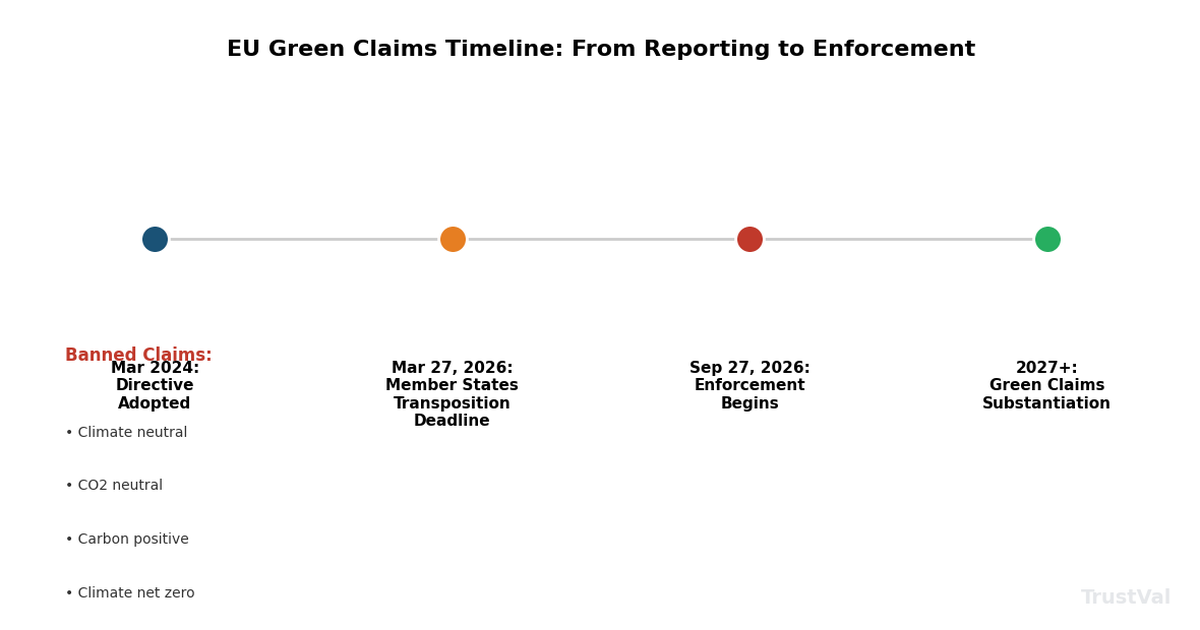
The directive bans the following claims, if based on offsetting alone: "climate neutral," "CO2 neutral certified," "carbon positive," "climate net zero," "climate compensated," "reduced climate impact," and "limited CO2 footprint." These are the words that populate corporate sustainability marketing, product packaging, and brand communications.
Member States must adopt implementing measures by March 27, 2026 — just two weeks from now — and enforce them starting September 27, 2026. The timeline is aggressive, and compliance teams across European companies are scrambling to understand the implications.
The penalties for non-compliance are substantial. Member States must impose fines of at least 4% of annual turnover earned in the EU market for companies making prohibited claims. For large multinational corporations, this can translate into hundreds of millions of euros in potential liability.
What Companies Can Still Do with Offsets
The directive does not ban carbon offsetting entirely. Instead, it redefines when and how offsets can be discussed. Under the new rules, companies can use offsets only for residual emissions — those emissions that remain after the company has reduced emissions "as much as possible" across its own operations and value chain.
This creates a hierarchy: first, reduce emissions directly. Second, improve efficiency and transition to cleaner energy and processes. Third, after all feasible reductions have been made, use offsets to address what remains.
The challenge with this approach is demonstrating that you have reduced emissions "as much as possible." The directive does not specify a precise threshold — 80% reduction? 95%? — leaving room for interpretation and potential regulatory disputes. Companies will need to prepare detailed documentation showing that they have invested in all materially cost-effective emissions reduction measures before turning to offsets.
Strategic Implication: Companies can still use carbon offsets, but only after demonstrating genuine emissions reductions. The offset purchase itself cannot be marketed as the main story. This shifts the narrative from "We bought offsets" to "We reduced our emissions AND used offsets for the residual portion."
The Interaction with the Green Claims Directive
The Greenwashing Directive is just one piece of an expanding regulatory framework. The separate Green Claims Directive (Directive 2024/825, the substantiation piece) adds a second layer of requirements. Even if a company makes a legally compliant claim under the Greenwashing Directive, the Green Claims Directive will require scientific, third-party verification of that claim.
Together, these directives create a dual-compliance regime. First, the claim must not be prohibited under the Greenwashing Directive (so no "climate neutral" based on offsets). Second, the claim must be substantiated with auditable evidence under the Green Claims Directive.
For carbon credit buyers, this means that offset suppliers will need to provide far more detailed documentation about the environmental integrity, additionality, and permanence of their credits. Vague marketing claims about "supporting clean energy projects in Africa" will not be sufficient. The substantiation must be specific, third-party verified, and defensible in a legal dispute.
Market Impact: From Marketing Tool to Technical Tool
The EU directive will reshape the voluntary carbon market globally, even for companies not selling in the EU. Why? Because many multinational corporations operate in the EU and will need to comply. As global supply chains are rarely segregated by geography, companies often adopt a single global sustainability standard rather than maintaining different claims for different markets.
The effect will be a shift in VCM demand drivers. For the past decade, the primary demand for offsets came from companies wanting to make "net zero" and "climate neutral" claims. That demand will evaporate in the EU and likely decline in other regions as companies preemptively adopt EU-compliant practices globally.
However, demand for offsets will not disappear. Instead, it will be driven by different factors: regulatory requirements in carbon accounting standards, corporate net-zero science-based targets that explicitly account for Scope 3 emissions, and the need to address residual emissions in hard-to-decarbonize sectors.
High-quality offsets — particularly those based on nature-based solutions or engineered carbon removal — will remain valuable. But the value proposition shifts from "help us claim climate neutrality" to "help us manage residual emissions responsibly." This should benefit the highest-integrity offset providers and penalize those dependent on making headline marketing claims.
Implementation Challenges and Timelines
Member States have until March 27, 2026 to adopt their national implementing measures. Some countries have already begun drafting guidance; others are still developing their approach. This creates uncertainty for companies trying to understand compliance requirements before the September deadline.
Additionally, the directive does not specify how "as much as possible" reductions should be quantified. Companies will need to work with their regulators, their auditors, and potentially their liability insurance teams to develop a defensible interpretation. A conservative approach would be to assume that any company claiming offsets use must document significant (60%+) direct emissions reductions. A more aggressive interpretation might allow offset use after demonstrating that further reductions have diminishing returns.
For international companies, there is also a question of how the directive will apply to supply chains. If a European retailer sources products from non-EU manufacturers, who is responsible for compliance? The retailer making the final consumer claim? The manufacturer? The supply chain intermediary? These questions will be resolved through enforcement actions and guidance from Member State authorities.
Implications for Corporate Carbon Buyers
Companies that have relied on offset purchases to make "net zero" or "climate neutral" claims will need to revisit their carbon strategies. The options are:
1. Double Down on Emissions Reductions: Invest in decarbonization projects that reduce Scope 1, 2, and 3 emissions. This is the only sustainable way to maintain credibility under the new regulatory regime.
2. Rephrase Communications: Instead of claiming "climate neutral," claim "reducing emissions by X% and offsetting residual emissions with high-quality carbon credits." This is compliant but less marketing-friendly.
3. Target Non-EU Markets: Some companies may choose to maintain offset-based claims in markets without similar restrictions, while adopting compliant language for EU sales. However, this creates supply chain complexity and reputational risk.
4. Exit the Offset Market: Some companies may reduce offset purchases entirely, especially if the reduction in marketing value makes the purchase economically unattractive. This will reduce VCM demand, putting downward pressure on credit prices.
Opportunity for High-Quality Credits
The directive's intent is to shift markets toward quality. Companies that can only make residual emission claims need offsets with exceptional environmental integrity. A marginal tree-planting project or a project of questionable additionality will not satisfy the "as much as possible" threshold in a legal compliance framework.
In this environment, engineered carbon removal credits, high-permanence nature-based solutions, and credits verified by internationally recognized standards (Gold Standard, Verra VCS, Puro) should see relative demand increases. Meanwhile, lower-quality, lower-priced credits may see demand declines.
This mirrors what we saw in compliance markets like the EU ETS, where regulatory clarity drove demand toward higher-quality allowances and away from marginal offset projects.
TrustVal's Perspective
The EU's Greenwashing Directive marks a turning point in the voluntary carbon market's maturity. For years, the VCM has been criticized for enabling "offset-based greenwashing" — companies making claims about climate action when in fact they were simply paying for offsets while doing little to reduce their own emissions.
The directive addresses this by severing the link between offset purchases and headline climate claims. This is not perfect policy — the definition of "as much as possible" is vague, and enforcement will be uneven. But it moves in a direction that aligns market incentives with actual emissions reductions.
For corporate buyers, the message is clear: offset strategies must evolve. Offsets are no longer a substitute for decarbonization; they are a complement to it. Companies that have built their carbon strategies entirely around offset purchases will need to fundamentally restructure their approach.
For offset providers, the directive creates both risk and opportunity. Risk comes from declining demand for lower-quality credits and the loss of marketing-driven demand. Opportunity comes from increased demand for high-integrity credits that genuinely support decarbonization and can pass the "as much as possible" scrutiny test.
The voluntary carbon market will be smaller after September 27, 2026, but it may be healthier. Quality will be rewarded. Integrity will be required. And climate progress will be the measure of success, not marketing claims.
TrustVal helps corporate buyers and project developers navigate carbon markets with confidence. Talk to our team about your carbon strategy.