The $5.8 Billion Carbon Removal Gold Rush: Why Forward Contracts Are Reshaping the Market
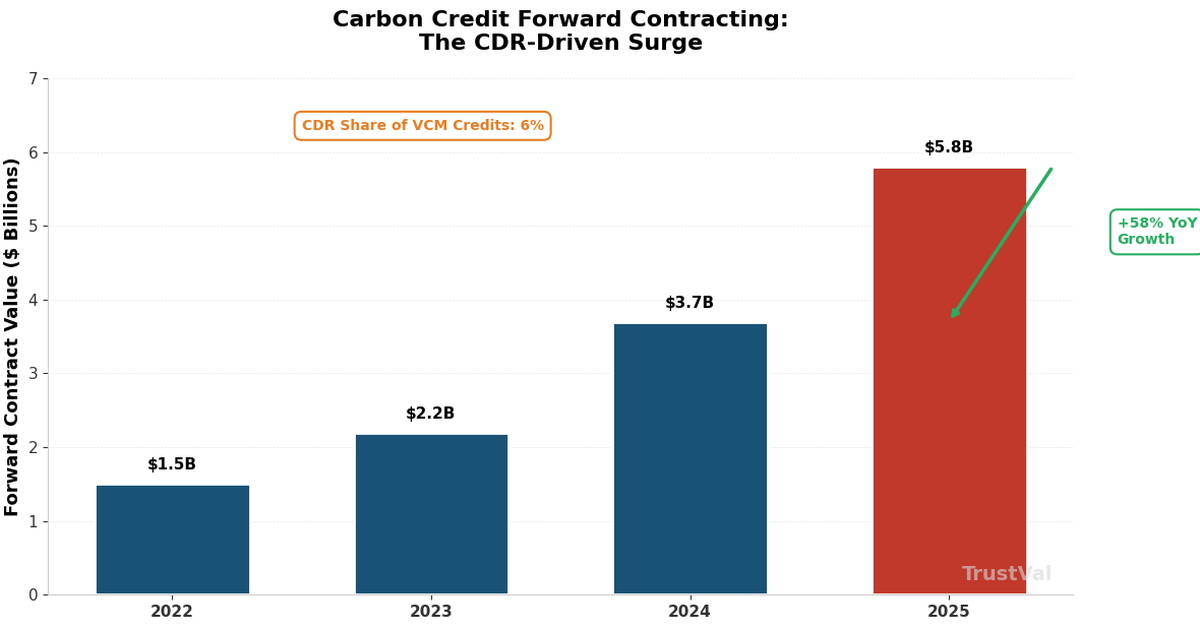
The voluntary carbon market has reached an inflection point. Forward carbon credit agreements — contracts where buyers commit to purchase credits for delivery in future years — surged 58% in 2025 to a record $5.8 billion. The driver is clear: engineered carbon removal.
Carbon removal (CDR) represents a tiny share of the voluntary carbon market today: just 6%. But the intensity of forward contracting activity in the CDR space signals something profound. Corporate buyers and carbon platforms have concluded that 2025-2026 is the critical window to lock in supply chains. After that window closes, capacity will be constrained, prices will spike, and opportunistic buyers will be left without access to the high-quality removal credits they need to meet 2030 net-zero targets.
This is not exaggeration. Supply-side data reveals a stark reality: 80% of high-durability carbon removal capacity is currently at risk. Without additional offtake agreements, that capacity will not be developed. For corporate buyers who have committed to science-based net-zero targets, this is an existential threat. The voluntary carbon market will not provide the removal credits they need unless they commit to buying them now.
The CDR Capacity Crisis
Carbon removal projects are expensive. Engineered removal — direct air capture, point source capture, enhanced weathering — requires significant capital investment and operates at high cost. Biochar, enhanced soil carbon, and other nature-based removal solutions require upfront ecosystem investment and land management commitments.
Unlike emissions reduction projects, which generate value immediately by reducing operational costs (energy efficiency, renewable energy procurement), CDR projects generate no operational value. Their only value comes from carbon credit sales. This creates a fundamental financing challenge: no CDR capacity gets built without an offtake agreement.
The data supports this. Of the cumulative carbon removal capacity that has been developed or is under development, fewer than 10% of CDR credits reviewed meet high-quality thresholds according to third-party verifiers. This is not a shortage of projects; it is a shortage of credits that meet the integrity standards required by corporate net-zero commitments.
Over 90 million tonnes of carbon removal have been contracted through forward agreements. But this figure masks a deeper problem: the majority of the CDR capacity in development pipelines lacks offtake agreements. Developers of enhanced weathering projects, point-source capture facilities, and biochar production operations are waiting for corporate buyers to commit before they make final investment decisions.
The Offtake Dependency: Carbon removal capacity is not constrained by technology or capital availability. It is constrained by corporate offtake demand. Without corporate buyers signing long-term contracts, developers will not invest. This creates a coordination problem that 2026 will determine.
The Biochar Bottleneck
Biochar — the process of converting biomass into stable carbon and burying or using it in agriculture — is among the most scalable and cost-effective carbon removal solutions available today. And the biochar market is reaching critical capacity constraints.
From 2022 through the first half of 2025, 3.04 million tonnes of biochar-based carbon removal were contracted through forward agreements. In just the first half of 2025 alone, 1.6 million tonnes of biochar carbon credits were sold — indicating accelerating demand.
But capacity is not keeping pace with demand. Of the available high-quality biochar carbon removal capacity for 2025, 62% has already been allocated through offtake agreements. For 2026, the picture is even more constrained: only 24% of available biochar capacity has been locked down, but the remaining capacity is rapidly being committed.
This means that any corporate buyer entering the biochar market in 2026 will face sharp price increases and limited availability. The companies that contracted biochar capacity in 2024-2025 at $20-30 per tonne now have long-term supply secured. New entrants will face spot market prices of $40-60 per tonne and limited forward contract availability.
Microsoft and the Concentration of Demand
Microsoft has emerged as the dominant purchaser of nature-based carbon removal. The company accounts for approximately 60% of all contracted nature-based CDR offtakes globally. This concentration reflects Microsoft's Net Zero Carbon Pledge and its explicit commitment to purchasing carbon removal credits to address residual emissions.
Microsoft's purchasing strategy is sophisticated: the company is willing to pay premium prices for high-quality, permanent carbon removal, and it is locking in multi-year, multi-jurisdictional offtake agreements. This has the effect of tightening supply for other corporate buyers and setting price floors.
The implication is clear: if Microsoft accounts for 60% of removal demand, and if Microsoft continues to expand its procurement volume to meet its net-zero targets, then the remaining 40% of removal capacity must be split among all other corporate buyers globally. For any given company, the available supply is extremely constrained.
The 2026-2030 Demand-Supply Mismatch
Corporate net-zero commitments require companies to remove carbon equivalent to their residual emissions by 2030. For companies in hard-to-decarbonize sectors — aviation, heavy industry, agriculture — residual emissions can be 20-40% of baseline emissions. For a large corporation, this translates into millions of tonnes of removal credits needed by 2030.
The math does not work out. Current CDR capacity development pipelines cannot supply the volume of removal credits needed to meet 2030 net-zero commitments across all committed corporations. Capacity is developing, but not fast enough or at sufficient scale.
This creates a crisis dynamic. Companies that do not lock in forward removal contracts now will face three options in 2028-2030: (1) pay exorbitant spot prices for whatever removal capacity is available, (2) cut or delay their net-zero commitments, or (3) accept failing to meet their commitments. None are attractive.
Strategic Imperative: For corporate buyers with genuine net-zero commitments, 2026 is not optional for entering the carbon removal market. It is the last viable window for securing supply at reasonable prices. Delay now means paying substantially higher prices, or failing to secure supply entirely.
Forward Contracting as De-Risking Mechanism
Forward carbon removal contracts serve multiple functions beyond simply reserving supply. They provide price certainty. A company signing a multi-year forward contract at $35 per tonne knows its maximum carbon removal cost through 2030, regardless of spot market volatility.
Forward contracts also provide development certainty to CDR project developers. When a developer receives a signed offtake agreement from a creditworthy buyer, that agreement becomes project financing collateral. Banks and climate funds are much more willing to finance CDR capacity when there is a corporate buyer committed to purchasing the credits.
From the buyer's perspective, forward contracting also enables strategic planning. Instead of competing in spot markets against other corporate buyers and private investors, a company can design a tailored removal procurement strategy: X tonnes of biochar at $25-30/tonne, Y tonnes of point-source capture at $50-70/tonne, Z tonnes of enhanced weathering at $15-25/tonne. This diversification reduces concentration risk and optimizes cost-effectiveness.
Quality Premium in CDR Markets
The forward contracting boom has also clarified quality hierarchies in the CDR market. Removal credits backed by permanent storage (enhanced weathering, direct air capture with geological sequestration) command premiums of 30-50% over removal credits with intermediate durability (biochar with decadal permanence commitments).
This reflects corporate buyer preferences. Science-based net-zero frameworks increasingly require that carbon removal credits meet long permanence thresholds (1,000+ years). Shorter-duration solutions are being downgraded in corporate accounting and climate commitments.
This has shifted developer incentives toward permanent removal solutions. The forward contracting boom is being driven largely by corporate demand for engineered removal — direct air capture, point source capture, and enhanced weathering — rather than nature-based solutions. This is a meaningful shift in the structure of carbon removal development.
Geographic Concentration and Supply Chain Risks
A significant share of forward-contracted carbon removal is concentrated in a small number of countries: the United States dominates engineered removal development, while biochar capacity is more globally distributed. This geographic concentration creates supply chain risks.
Policy changes, permitting delays, or changes in climate or carbon pricing policy in key jurisdictions could disrupt supply chains. Companies with geographically concentrated removal portfolios face concentration risk. Those with diversified portfolios across multiple jurisdictions, technologies, and permanence profiles are better positioned.
Forward contracting enables geographic diversification. Instead of responding reactively to supply availability, companies can design geographic strategies and lock in offtake agreements across multiple regions and technologies.
The Role of Intermediaries and Carbon Platforms
The forward contracting boom has been enabled by intermediaries and carbon platforms that aggregate CDR projects and offer diversified removal portfolios to corporate buyers. These platforms handle project due diligence, credit issuance, and contract management, reducing transaction costs for corporate buyers.
Platforms like Frontier Climate, Wren, Carbon Direct, and others have emerged as primary channels for corporate removal purchases. They negotiate offtake agreements on behalf of multiple corporate buyers, bundle projects, and manage counterparty risk.
This intermediation reduces friction in the forward contracting market and increases velocity. Corporate buyers can sign framework agreements with platforms and adjust portfolio composition as new projects come online, rather than negotiating project-by-project with individual developers.
TrustVal's Perspective: 2026 as a Watershed Moment
At TrustVal, we see the forward contracting boom in carbon removal as a watershed moment. For years, the voluntary carbon market has been dominated by compliance-driven purchasing and low-cost reduction credits. That era is ending.
The emerging era is focused on removal, quality, permanence, and credibility. Companies with genuine net-zero commitments are making strategic decisions about carbon removal procurement. They are locking in supply, diversifying across technologies and geographies, and building removal portfolios that will support their 2030 commitments.
The data is unambiguous: 80% of high-durability CDR capacity is at risk without additional offtake agreements. This is not a theoretical problem; it is a current crisis. CDR developers are waiting for corporate commitment before investing. If that commitment does not materialize in 2026, the development pipeline will stall, capacity will be constrained, and 2030 net-zero targets will become unachievable.
For corporate buyers, the strategic imperative is clear. If your organization has committed to a science-based net-zero target, and if that target requires carbon removal credits by 2030, then 2026 is the critical year for entering the forward contracting market. The window is closing. After 2026, the supply will be allocated, prices will rise, and options will be limited.
The $5.8 billion in forward carbon credit contracts signed in 2025 represents rational corporate strategy: locking in supply, managing price risk, and securing the removal credits needed to meet climate commitments. The 2026 contracting season will determine whether that volume increases further, maintains, or declines. For the future of carbon removal markets and 2030 net-zero commitments, the answer matters tremendously.
Sources
TrustVal helps corporate buyers and project developers navigate carbon markets with confidence. Talk to our team about your carbon strategy.