SBTi Net Zero Standard V2: Carbon Credits Get Official Recognition in Corporate Climate Strategy
The Science Based Targets initiative (SBTi) is preparing to publish the final version of its Corporate Net-Zero Standard V2 in mid-2026. This update represents the most significant change to corporate climate target-setting in years: for the first time, high-integrity carbon credits receive formal recognition as part of a company's net-zero pathway.
The implications ripple across the entire voluntary carbon market. SBTi-validated targets guide over 10,000 companies worldwide. When SBTi speaks, corporate sustainability budgets listen.
From "Beyond Value Chain" to "Ongoing Emission Responsibility"
The draft standard introduces a fundamental reframing. The term "beyond value chain mitigation" (BVCM) — previously used to describe voluntary carbon credit purchases — is replaced by "ongoing emission responsibility."
This is more than semantic. The new framing elevates carbon credit purchases from a nice-to-have add-on to a structured component of corporate accountability. Companies pursuing the highest level of SBTi recognition must now demonstrate that they are taking measurable responsibility for emissions they cannot yet eliminate.
The 40% Rule
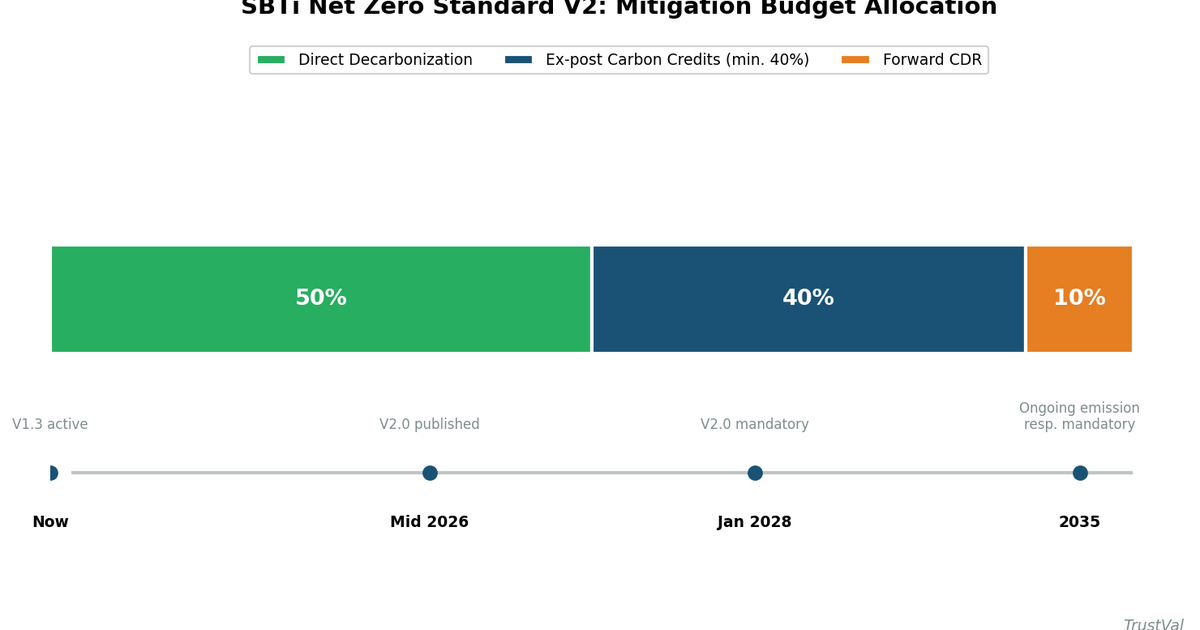
Under the draft V2 standard, companies seeking top-tier recognition must spend a minimum of 40% of their calculated mitigation budget on ex-post carbon credits — verified, high-integrity credits representing real emissions reductions or removals that have already occurred.
This floor creates predictable demand for quality credits. It signals to project developers and investors that SBTi-aligned corporate demand for verified credits will scale significantly as the standard takes effect.
Transparency as the New Currency
Even companies that choose not to purchase carbon credits face new obligations. The V2 standard mandates that all target-setting companies publicly disclose whether they plan to take responsibility for ongoing emissions. If they opt out, they must explain why.
Companies that do participate must report annually on: - The methods they use to address ongoing emissions - The rationale for their chosen carbon price - The volume and type of carbon credits purchased
This transparency mechanism creates market pressure. No company wants to be the one publicly explaining why it chose not to invest in climate action beyond its own operations.
Timeline and Transition
The existing Corporate Net-Zero Standard (V1.3) remains active for new target-setting until December 2027. From January 1, 2028, all companies setting new SBTi-validated targets must use V2.0.
This gives the market roughly 18 months to prepare. Credit registries, rating agencies, and project developers should expect a surge in corporate demand for high-integrity credits as companies align their procurement strategies with the new requirements.
TrustVal's Perspective
At TrustVal, we view the SBTi V2 standard as validation of what the market has needed: a credible framework that connects corporate climate ambition with high-integrity carbon credit demand.
The 40% ex-post requirement is particularly significant. It eliminates the ambiguity around forward-looking carbon credit commitments and creates a clear purchasing mandate tied to verified outcomes. For carbon credit valuation — our core expertise — this creates a more transparent and predictable demand signal.
We expect the V2 standard to accelerate the quality premium in carbon markets. Companies subject to SBTi disclosure requirements will preferentially purchase credits with strong integrity ratings, further widening the price gap between high- and low-quality assets.
The message for corporate buyers: start building your procurement strategy now. The credits that meet SBTi V2 requirements — independently verified, high-integrity, ex-post — are already in tight supply. Waiting until 2028 means competing in a seller's market.
---
TrustVal provides carbon market advisory and valuation services. For more information, visit trustval.com.
Sources
TrustVal helps corporate buyers and project developers navigate carbon markets with confidence. Talk to our team about your carbon strategy.