The Quality Premium Explodes: High-Integrity Carbon Credits Now Cost 4x More Than Low-Quality Alternatives
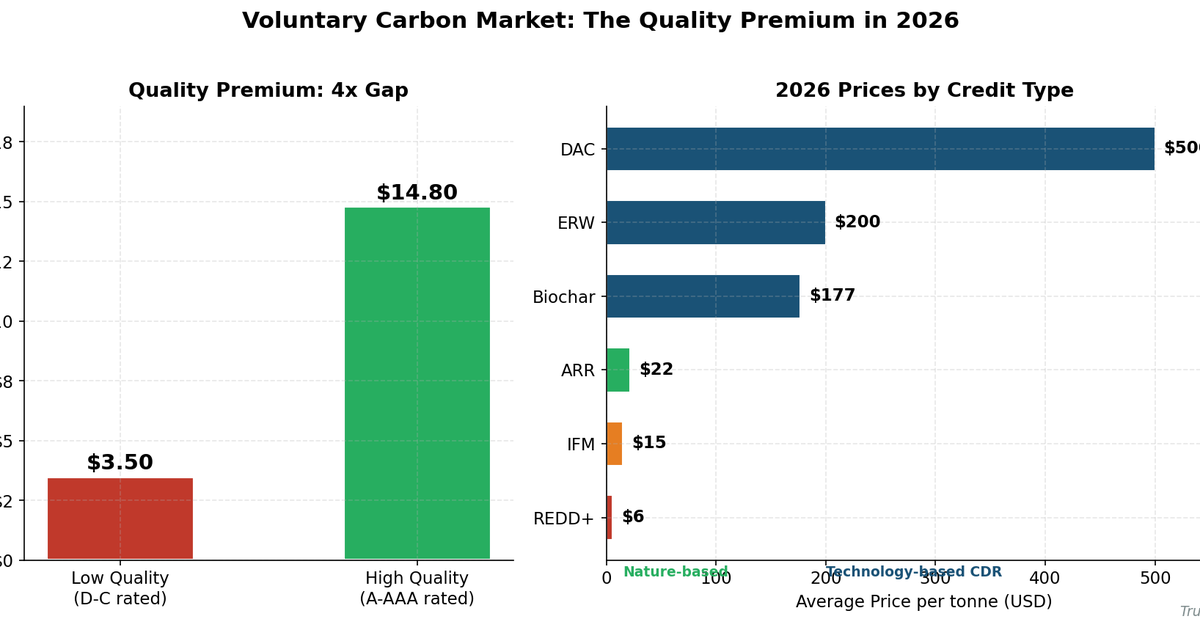
A striking data point defines the 2026 voluntary carbon market: high-integrity carbon credits rated A to AAA now trade at $14.80 per tonne — four times the price of low-quality credits at $3.50 per tonne.
This 4:1 quality premium is not a temporary anomaly. It reflects a structural shift in how buyers evaluate and purchase carbon credits. The era of cheap, undifferentiated offsets is ending. In its place, a two-tier market is emerging where integrity commands a measurable financial premium.
What's Driving the Split?
Three forces are converging to widen the quality gap:
Regulatory pressure. The EU's Green Claims Directive and the Empowering Consumers Directive, both taking effect in September 2026, will ban generic environmental claims based purely on offsetting. Companies face fines of up to 4% of annual EU turnover for greenwashing. This makes credit quality a compliance issue, not just a reputational one.
Standard convergence. The ICVCM's Core Carbon Principles (CCP) label is becoming the market's quality benchmark. CCP-labeled credits demonstrate additionality, permanence, and robust monitoring — the attributes buyers need to defend their climate claims. Supply of CCP-labeled credits is growing but remains constrained relative to demand.
Corporate procurement maturity. Corporate buyers — guided by frameworks like the SBTi Net Zero Standard V2 and supported by credit rating agencies like Sylvera and BeZero — are increasingly sophisticated in their purchasing criteria. The days of buying the cheapest available credit to check a box are numbered.
Price Landscape by Credit Type
The voluntary carbon market in 2026 is not a single market. It's a collection of micro-markets, each with distinct pricing dynamics:
Nature-based credits: - Afforestation/Reforestation (ARR): ~$22/tonne - Improved Forest Management (IFM): ~$15/tonne - REDD+ (avoided deforestation): ~$6/tonne
Technology-based carbon removal: - Biochar: ~$177/tonne - Enhanced Rock Weathering (ERW): $200+/tonne - Direct Air Capture (DAC): $500+/tonne
The price spread within nature-based credits alone — from $6 for REDD+ to $22 for ARR — reflects the market's evolving assessment of permanence risk and additionality. REDD+ credits, which dominated the market by volume for years, trade at steep discounts as buyers question their long-term integrity.
The Demand Paradox
Despite a 227% surge in corporate climate commitments in 2025, actual credit retirements fell 7% to 157 million tonnes. The market expected demand to exceed 1 billion tonnes by 2030. That projection now looks overly optimistic.
The paradox: companies are committing more but buying less. The explanation lies in quality uncertainty. Buyers hesitate to purchase credits they cannot confidently defend to regulators, investors, and the public. They would rather delay procurement than risk a greenwashing accusation.
This hesitation creates a self-reinforcing cycle. Reduced demand depresses prices for lower-quality credits, making it harder for marginal projects to attract investment, while high-quality projects command premium prices and attract disproportionate capital.
CORSIA Adds Compliance Demand
The aviation industry's Carbon Offsetting and Reduction Scheme (CORSIA) is injecting significant new demand into the quality segment. Airlines required 58 million tonnes of credits to cover 2024 emissions, with an estimated 78 million tonnes of additional demand in 2026.
CORSIA's eligible credit criteria align closely with high-integrity standards, channeling aviation demand toward the premium end of the market. The first phase (2024–2026) has been constrained by supply bottlenecks — at one point, a single government forestry project in Guyana represented nearly all eligible supply.
TrustVal's Perspective
At TrustVal, the quality premium validates our core thesis: carbon credit valuation requires the same rigor applied to any financial asset. A credit's price should reflect its measurable integrity attributes — additionality, permanence, co-benefits, and monitoring quality — not just its project type or registry.
The 4:1 quality premium creates both risk and opportunity. For buyers, it means procurement decisions carry real financial weight. Overpaying for low-quality credits wastes capital; underpaying for high-quality credits may not be possible much longer as supply tightens.
For project developers, the premium rewards investment in integrity. Projects that invest in robust monitoring, transparent reporting, and independent verification capture significantly more value than those that cut corners.
Our advice to market participants: treat carbon credits as assets, not commodities. The quality premium will continue to widen as regulatory frameworks tighten and corporate disclosure requirements expand. Position your portfolio accordingly.
---
TrustVal provides carbon market advisory and valuation services. For more information, visit trustval.com.
Sources
TrustVal helps corporate buyers and project developers navigate carbon markets with confidence. Talk to our team about your carbon strategy.