EU CBAM Enters Compliance Phase: What Carbon-Intensive Importers Must Do by March 31
The EU's Carbon Border Adjustment Mechanism (CBAM) moved from reporting to enforcement on January 1, 2026. For the first time, importers of carbon-intensive goods into the European Union face binding financial obligations tied to the embedded carbon in their products.
This marks a fundamental shift in global trade policy. Carbon costs, once confined to domestic producers under the EU Emissions Trading System (EU ETS), now extend to foreign manufacturers. The playing field is leveling — and the clock is ticking.
The March 31 Deadline
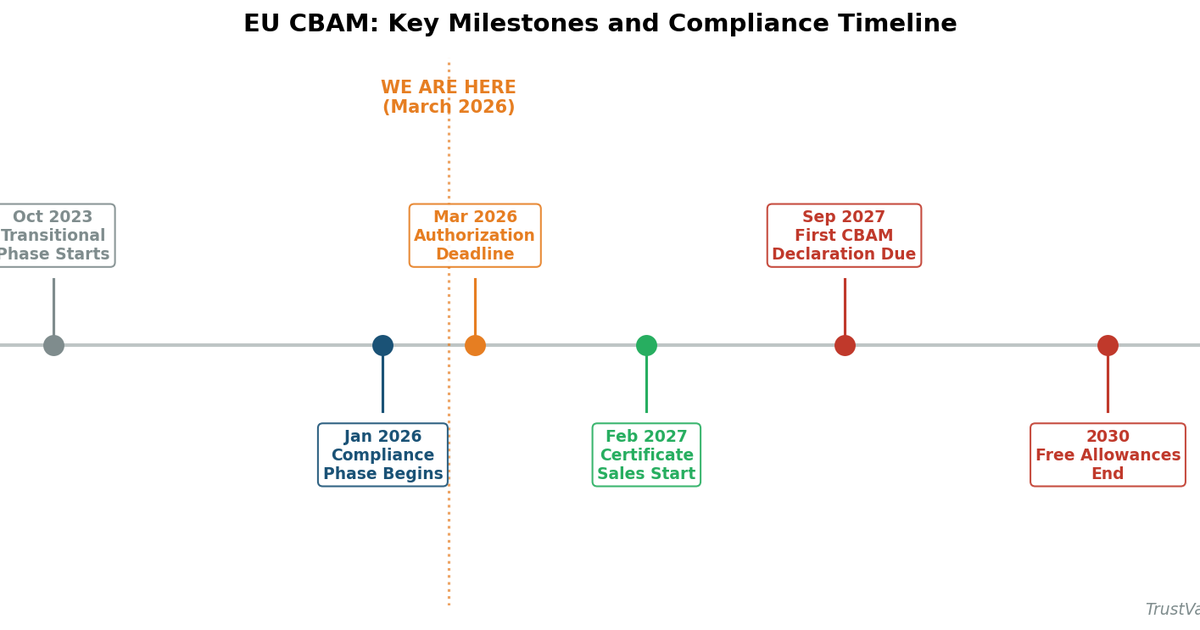
EU importers — or their customs representatives — who bring in more than 50 tonnes of CBAM-covered goods annually must apply for authorized declarant status by March 31, 2026. Under the recently adopted Omnibus simplification package, importers who were already active before January 1 may continue importing, provided they submit their authorization application by this deadline.
Below 50 tonnes, importers are fully exempt from CBAM obligations — no reporting, no authorization, no certificate purchases. This threshold was introduced to reduce administrative burden on smaller operators.
Which Sectors Are Affected?
CBAM covers six product categories selected for their carbon intensity and carbon leakage risk:
- Cement - Iron and steel - Aluminium - Fertilisers - Electricity - Hydrogen
Selected precursors — intermediate goods used to manufacture these products — also fall within scope. Importers must track the embedded emissions across their supply chains and prepare for the first surrender of CBAM certificates in September 2027, covering all 2026 imports.
What This Means for Carbon Markets
CBAM fundamentally links the EU's internal carbon price to international trade. As free allowances under the EU ETS are phased out — sectors without significant carbon leakage risk will receive only 30% free allocation in 2026, declining to zero by 2030 — CBAM certificates will mirror the EU ETS price.
The EU ETS carbon price is projected to average €85 per tonne in 2026, an 18% increase year-over-year. With allowance supply dropping roughly 8% compared to 2025, the market is tightening mechanically.
For companies outside the EU, this creates a direct financial incentive to decarbonize. Producers in jurisdictions with their own carbon pricing can deduct those costs from their CBAM obligations, making domestic carbon taxes and ETS participation strategically valuable.
TrustVal's Perspective
At TrustVal, we see CBAM as the most consequential carbon policy development of 2026. It transforms carbon from an environmental externality into a trade cost — measurable, auditable, and financially material.
For our clients in carbon-intensive supply chains, the implications are clear: accurate emissions measurement and reporting are no longer optional. The companies that invest in robust MRV (measurement, reporting, and verification) systems now will hold a competitive advantage as CBAM obligations scale.
The convergence of compliance and voluntary carbon markets is accelerating. Companies that previously treated carbon credits as purely voluntary commitments now operate in a world where carbon costs are embedded in trade policy. Understanding this landscape — and navigating it strategically — is what TrustVal helps organizations do.
What Companies Should Do Now
1. Verify your exposure: Determine whether your imports exceed the 50-tonne threshold for CBAM-covered goods. 2. Apply for authorization: If applicable, submit your authorized declarant application before March 31, 2026. 3. Map embedded emissions: Begin collecting emissions data from your non-EU suppliers for the six covered sectors. 4. Budget for CBAM certificates: Factor in carbon costs at approximately €85/tonne when forecasting 2026 import costs. 5. Engage your supply chain: Communicate CBAM requirements to suppliers and explore decarbonization partnerships.
---
TrustVal provides carbon market advisory and valuation services. For more information, visit trustval.com.
Sources
TrustVal helps corporate buyers and project developers navigate carbon markets with confidence. Talk to our team about your carbon strategy.